Validating Data Quality at the Ingestion Layer of ML Pipelines
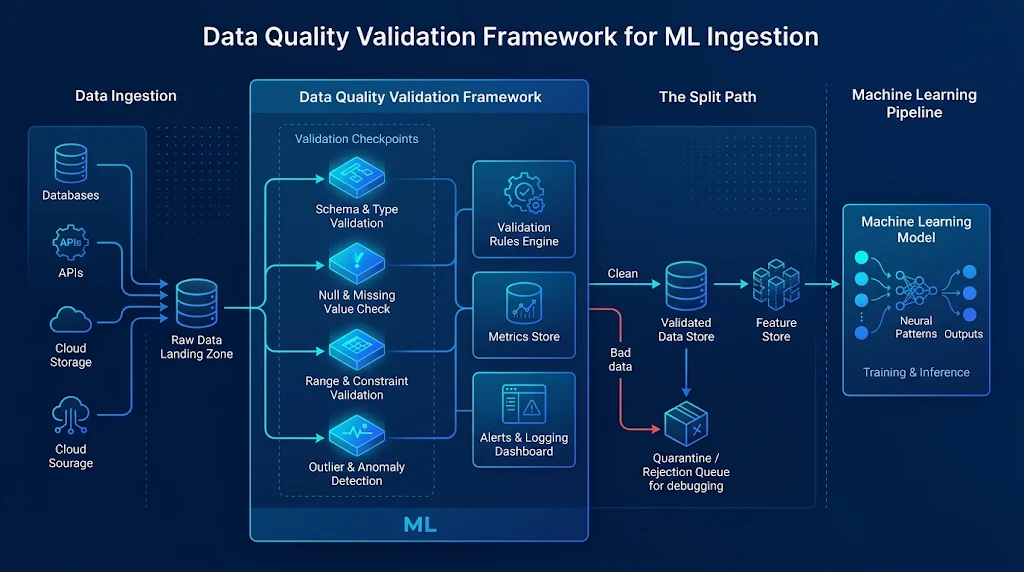
When enterprise machine learning models decay, the cause is seldom an abrupt defect in the neural network design; far more often the data pipelines feeding them have quietly worsened. The old saying “garbage in, garbage out” carries even more weight in production ML, where upstream schema drift, unexpected nulls and moving distributions can set off severe errors in downstream predictions. Checking data only when the model is evaluated comes too late in the lifecycle. The fix belongs where data first arrives: the ingestion layer. With rigorous data quality validation frameworks in place at ingestion, MLOps teams can catch anomalies before they corrupt feature stores or contaminate training datasets. This guide covers the basic dimensions of data quality and the main software frameworks, from TensorFlow Data Validation to PyDeequ, that build resilience into today’s machine learning ingestion pipelines.
The Dimensions of Data Quality in Machine Learning
Quality dimensions give engineering teams an organized taxonomy for judging whether a dataset can really be used for algorithmic processing. Handling data quality as something you can measure, not as a vague idea, matters a great deal when debugging complicated pipelines and working through incidents as a team. During ingestion, every incoming data stream should be assessed along a few core dimensions:
- Accuracy: How correct the collected data actually is. When raw inputs are factually wrong, a machine learning model will necessarily learn a distorted picture of the problem it is meant to solve.
- Completeness: Missing data is something machine learning algorithms cope with badly, and completeness validation makes sure values are not absent. Gaps, particularly ones that appear at random with no traceable cause, contribute no extra predictive signal and frequently interfere with matrix operations. Null checks are the direct way to measure completeness.
- Consistency: Collection methods need to stay reliable over time, so that values remain consistent across different date ranges, monthly or yearly for example. Poor representation or inconsistency in categorical variables can seriously degrade what the model learns.
- Conformity and Schema: This dimension means every ingested payload matches the schema it is expected to follow. Data types, column names, date formats and permitted numerical ranges should all be strictly checked before any processing takes place.
- Stability and Timeliness: Stability concerns how consistent the distributions of time-series variables remain. Seasonality nobody accounted for, or an abrupt underlying trend, can sharply undermine model stability if ingestion does not check for it. Freshness checks, meanwhile, confirm that data is delivered on time.
A Multi-Stage Workflow for Validating Ingested Data
Building data quality into ingestion means placing firm validation gates at the moment data reaches your system. This protective stance keeps faulty or unusable data from seeping into the data used for training. Mature ML ingestion generally moves through the following phases in order:
- Initial Cleaning: Ahead of any sophisticated algorithmic validation, the pipeline takes care of basic structural work: removing duplicates, normalizing timestamp formats and dealing with missing values.
- Schema Validation: Here the pipeline strictly enforces the data’s structural contract, setting limits on the size of output tables and on minimum or maximum column values. That reduces the chance of taking in unwanted records that misrepresent the real-world problem.
- Anomaly and Outlier Detection: Because anomalies can skew mathematical model output out of all proportion, ingestion must isolate and handle them straight away using a range of statistical methods.
- Bias Detection: Current ingestion workflows look for, and reduce, biases linked to sensitive attributes. Keeping biased data out of the training pool is an important step toward fairness, since biases buried in collected data can cause high-impact models to develop discriminatory tendencies.
- Final Approval: Data is formally cleared for downstream feature engineering and model training only after it has passed every configured validation checkpoint.
Comparing the Leading Data Validation Frameworks
Running workflows this rigorous at enterprise scale requires dedicated validation frameworks. Which tool fits best depends largely on the infrastructure underneath (Apache Spark versus Python microservices, for instance) and on the particular operational needs of the ML team.
1. TensorFlow Data Validation (TFDV)
TFDV was created within the TensorFlow Extended (TFX) ecosystem as a purpose-built library for analyzing and validating machine learning data. In contrast to general data engineering tools, it is closely tuned to the particular ways predictive models fail.
- Schema Inference and Constraints: By inspecting the training data, TFDV generates a schema automatically that captures expectations about data types and acceptable ranges. Engineers can then look over that generated schema, adjust it where needed, commit it to version control and deploy it into the pipeline for ongoing validation.
- Training-Serving Skew Detection: One of TFDV’s most important features is spotting training-serving skew, which arises when the data sent to request predictions in production is produced in a different way from the training data. TFDV finds this distribution skew by comparing examples from the training and serving datasets side by side.
- Drift Detection: TFDV identifies data drift by looking at a sequence of data over time. Through its Facets integration in Jupyter notebooks, it offers built-in visual tools for finding questionable feature distributions, missing values and labels of the wrong type.
2. Great Expectations (GX)
GX Core, the open-source edition of Great Expectations, is commonly regarded as one of the world’s most widely used open-source data quality frameworks, built to give teams confidence in analytics and ML pipelines. Engineering teams write highly configurable assertions, called “Expectations,” directly in Python.
- Expectation Suites: A suite bundles checks covering schema, completeness, allowed values, uniqueness and custom rules specific to the business domain.
- Automated Data Docs: Among GX’s biggest advantages is that it can render visualizations and gather test results into readable “Data Docs” automatically. Raw technical tracebacks become plain language, which helps build agreement and improves communication with stakeholders who are not technical.
- Pipeline Orchestration: GX fits smoothly into workflow orchestrators such as Apache Airflow. When Actions are defined next to Expectations, GX can stop a workflow on detecting bad data, keep that data from flowing on into the model, and alert the relevant teams at once.
3. PyDeequ
PyDeequ is the standard choice for teams handling very large datasets on distributed compute. It is the Python API wrapper around AWS Deequ, a library built natively on Apache Spark, and it lets users write “unit tests for data” that run across large clusters.
- Fluent API and Statistical Analyzers: Its declarative, fluent API allows engineers to chain several statistical analyzers into one run. On numeric datasets it computes complex metrics quickly across distributed nodes.
- Constraint Verification: With its core
VerificationSuite, a team attaches a Spark DataFrame and runs checks for completeness, uniqueness, distinctness and value ranges, all while the data stays inside the cluster. - Scalable Data Quality: Since it builds on Spark’s distributed processing, PyDeequ ensures data integrity, accuracy and consistency even for huge datasets measured in terabytes.
4. Soda Core
Platform teams that want something lighter and more agile, and that lean heavily on automation, can turn to Soda Core as a solid declarative option.
- YAML-Based Configuration: Checks are expressed in SodaCL, a language based on YAML, which analytics engineers find very approachable and which reviewers can read easily in a Git pull request.
- CI/CD Integration: The tool is built to live near deployment automation. Teams can quickly set up null, schema and freshness checks against widely used data lakes and warehouses, without the heavier scaffolding of a Python project that frameworks such as Great Expectations demand.
Best Practices for Running Validation in Production
Picking a validation framework is just the beginning. Real reliability requires MLOps teams to enforce firm boundaries in the pipeline. Validation checkpoints ought to be idempotent, so that running them again is safe and never corrupts the state of the ingestion queue.
Schema evolution also needs careful handling. Data definitions are bound to change as upstream applications change. Great Expectations and similar frameworks deal with this by letting engineers validate column names dynamically and use schema inference to adjust expectation suites as time goes on. The overall aim is to push quality checks as early in the pipeline as they can go, that is, as far left as possible. Stopping anomalies at ingestion ensures your machine learning models train only on structured, trusted and thoroughly validated information.
Frequently Asked Questions
Q: What separates data quality validation from model validation?
Data quality validation happens at the ingestion layer and confirms that raw inputs satisfy strict requirements for schema, accuracy and completeness. Model validation takes place once training is done and measures how well the algorithm generalizes to new data, with metrics such as precision and recall.
Q: Why choose PyDeequ over validation tools built on Pandas?
Tools based on Pandas need the whole dataset to fit into one machine’s memory, which is not workable for enterprise data at terabyte scale. Because PyDeequ runs on Apache Spark, it can spread the work of statistical analyzers and quality checks efficiently across big clusters.
Q: Why is training-serving skew risky, and what is it?
Training-serving skew is when feature values in the training data are distributed very differently from the serving data used to ask for predictions in production. It is risky because the model ends up predicting from distributions that do not match the real-world environment, and production performance drops sharply as a result.
Q: How do tools such as Great Expectations explain failures to non-technical teams?
Great Expectations produces “Data Docs” automatically, which are visual reports anyone can read. They turn test failures expressed in code into plain language, so analysts, data stewards and business stakeholders can see exactly what the data quality problem is.
Sources
- Prometeia: article on why data quality and validation matter for machine learning
- Qualytics: guide to data quality frameworks, moving from reactive to reliable
- Unstructured: framework for data quality during the ingestion stage
- Great Expectations: GX Core, the open-source data quality platform
- DataCamp: tutorial on validating data in Python with Great Expectations
- Digna.ai: roundup of 10 free tools for validating data in a modern data stack
- Eduardo Avelar: overview of TensorFlow Data Validation
- TensorFlow TFX Guide: checking and analyzing data using TFDV
- Data Engineer Things: hands-on PyDeequ tutorial for data quality checks
- PyPI: the data-quality-validation-pydeequ framework
- AWS Labs: GitHub repository for python-deequ