Automating CI/CD and Continuous Training for Enterprise AI Models
Shipping conventional software through CI/CD (Continuous Integration and Continuous Delivery) pipelines is now standard practice across the industry. Carrying those deterministic workflows over to Machine Learning (ML) and Artificial Intelligence (AI) models at enterprise grade, however, raises architectural problems of its own. AI models, unlike ordinary code, rely heavily on stochastic training runs, very large data distributions, changing feature stores, and model drift that never stops. Without a sturdy, automated MLOps pipeline, companies run into serious release bottlenecks, models that decay in production, and manual mistakes that push back time-to-market.
This in-depth guide covers the structural designs, toolchains, testing protocols, and release strategies needed to put production-grade automated CI/CD pipelines in place for enterprise AI models.
1. How AI CI/CD Architecture Differs from Traditional CI/CD
Conventional CI/CD pipelines center on version control, unit and integration testing, containerization, and rolling releases. AI/ML pipelines, frequently called MLOps pipelines, widen that scope considerably by adding three continuous loops at their core: Continuous Integration (CI), Continuous Training (CT), and Continuous Delivery (CD).
+-------------------------------------------------------------------+
|                     Enterprise AI CI/CD & CT                      |
+-------------------------------------------------------------------+
       |                                   |
       v                                   v
[Continuous Integration]          [Continuous Training]
- Code & Schema Validation        - Trigger-based Retraining
- Automated Data/Model Tests      - Hyperparameter Tuning
       |                                   |
       +-----------------+-----------------+
                         |
                         v
              [Continuous Delivery]
              - Model Registry & Packaging
              - Canary & Blue-Green Rollouts
              - Automated Production Monitoring
Main Differences Between the Pipeline Stages:
- Version Control: For AI, versioning has to cover more than code in Git; it also spans model artifacts (Weights & Biases, MLflow) and huge training datasets (Pachyderm, DVC).
- Testing Suites: On top of ordinary unit tests for code, AI pipelines need tests that validate the data, typically with Great Expectations, plus model validation tests that examine bias, fairness, latency limits, and baseline accuracy.
- Deployment Targets: A model may ship as a serverless function, as a microservice sitting behind an API gateway, or as a package for edge devices, and each calls for dynamic allocation of GPU or TPU resources.
2. Building an Enterprise AI CI/CD Pipeline Step by Step
An automated pipeline that runs from end to end means tying together orchestration engines, code repositories, monitoring platforms, and artifact stores.
Step 1: An Automated Pipeline for Data Validation and Feature Engineering
Every dependable AI model rests on its data. The CI pipeline has to start any time the feature definitions or the raw data pipelines change.
- Tooling: Apache Airflow, Great Expectations, and Feast as the Feature Store.
- Workflow: Incoming raw data is checked against schema and statistical rules and then turned into features. When validation fails, the pipeline stops and the data engineering team receives an alert.
Step 2: Continuous Integration (CI) for Training and Evaluating Models
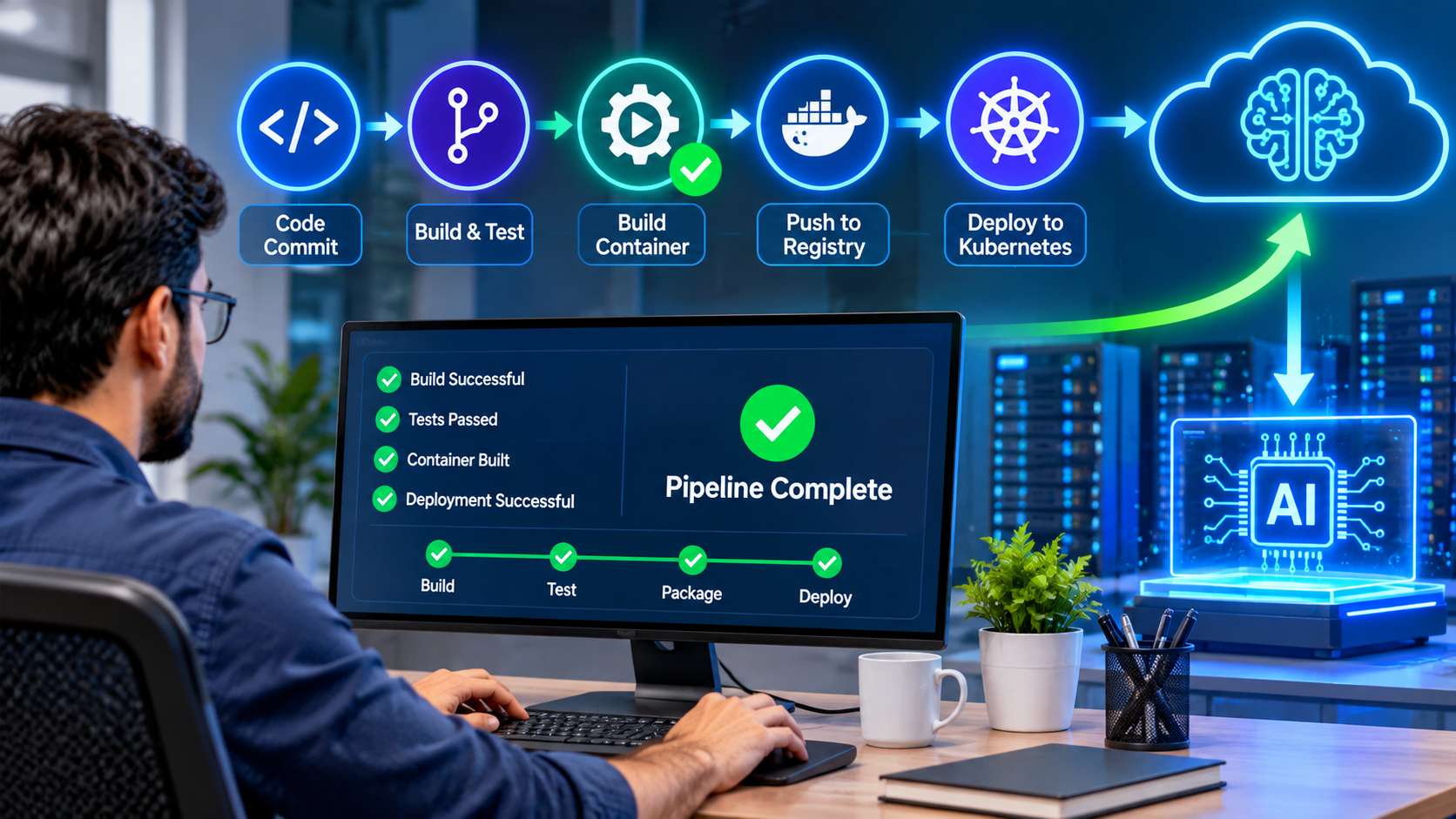
When data validation succeeds, the CI engine, for example GitHub Actions or GitLab CI, launches automated model training in isolated, containerized environments.
Training & Logging: The code fetches the verified dataset, runs the training scripts, and records metrics such as loss, accuracy, and F1-score straight into an MLflow Model Registry.
Automated Quality Gates: No model artifact is promoted until it clears a set of strict automated evaluation gates:
- Baseline Comparison: The freshly trained model has to beat the model currently in production by a set margin, such as +1.5% accuracy.
- Inference Latency Check: Under load testing, P99 latency has to stay below 50ms.
- Security & Vulnerability Scan: Trivy or Anchore scans container images for Common Vulnerabilities and Exposures (CVEs).
Step 3: Continuous Delivery (CD) and Gradual Model Rollouts
In a typical web app, a bug prompts an immediate rollback, but an AI model can fail quietly through gradual concept drift or slipping prediction confidence. That is why CD for AI depends on progressive delivery strategies.
- Canary Deployments: Direct between 5% and 10% of live production traffic at the new version of the model and compare its real-time telemetry with that of the legacy model.
- Shadow Deployments: Operate the new model alongside production and feed it live inputs while withholding its outputs from end users, so inference behavior can be checked safely under real production load.
3. Case Study: Rolling Out Large-Scale Forecasting Models
To show how these ideas play out, picture an enterprise supply chain business that runs more than 1,500 separate predictive models across distribution centers worldwide.
The Challenge:
Because deployments were manual, models went stale, hyperparameter settings went undocumented, and predictions regularly went offline whenever upstream data schemas changed without warning.
The Automated Solution:
- Orchestration: The main training scripts were moved into containerized Kubeflow Pipelines on Kubernetes clusters.
- GitOps Integration: ArgoCD was introduced to keep the model deployment manifests held in Git repositories in sync with the production Kubernetes clusters.
- Automated Rollback Triggers: Prometheus and Grafana dashboards were connected to alerting rules. Whenever prediction error rates climb past 3.5% across a sliding 15-minute window, the system falls back immediately and automatically to the last stable model artifact kept in MLflow.
4. Managing Model Drift and Continuous Training (CT)
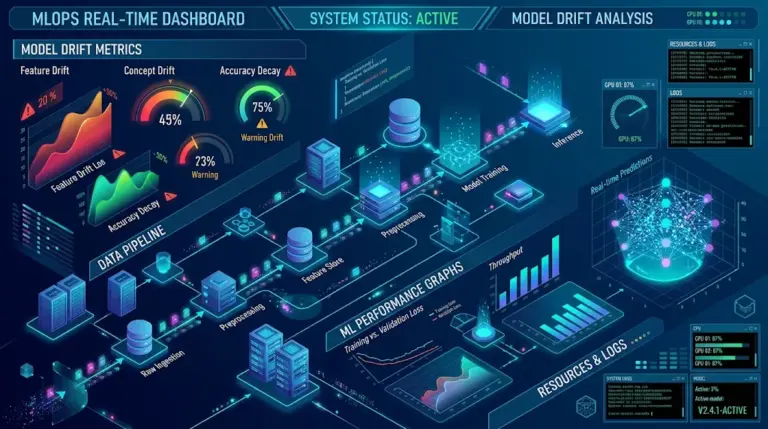
No enterprise AI CI/CD pipeline is complete unless a closed feedback loop deals with data drift and concept drift.
- Monitoring Drift: The system has to keep calculating statistical divergence measures, such as the Population Stability Index (PSI) or Wasserstein distance, comparing the feature distributions seen in training with the features arriving in production.
- Automated Retraining Triggers: Once drift passes its threshold, webhook notifications start automated retraining pipelines in Airflow, so the model repairs itself with no human involvement.
Frequently Asked Questions
Q1: In what ways do AI CI/CD pipelines differ from conventional software CI/CD?
Conventional CI/CD is mostly concerned with compiling code, running unit tests, and determinism. AI CI/CD also has to handle non-deterministic training runs, huge datasets, model weights, data validation, experiment tracking, and ongoing monitoring for model drift.
Q2: What tools does an enterprise MLOps pipeline need?
The main pieces are orchestration engines (Airflow, Kubeflow), version control for data (Pachyderm, DVC), model registries and experiment tracking (Weights & Biases, MLflow), and CI/CD runners (ArgoCD, GitLab CI, GitHub Actions).
Q3: How do we stop a biased or inaccurate AI model from being deployed automatically?
Put automated quality gates into the CI phase. Those gates apply firm criteria before any promotion to the staging or production registry: the candidate model must beat the legacy model’s accuracy thresholds, pass bias and fairness evaluations, and satisfy demanding latency benchmarks.
References & Further Reading
- Sculley, D., et al., “Hidden Technical Debt in Machine Learning Systems,” NeurIPS (Advances in Neural Information Processing Systems), 2015.
- “MLOps: Continuous delivery and automation pipelines in machine learning,” published in the Google Cloud Architecture Center.
- From the Microsoft Azure Architecture Guide: the “Machine Learning Operations (MLOps)” framework.