Runtime Guardrail Architecture to Protect Production LLMs from Prompt Manipulation
Many enterprise AI teams begin from a risky premise: that a carefully written system prompt works as a security boundary. Once in production, it does not. A large language model reads user queries, retrieved enterprise documents and system instructions as one continuous token stream. The attention mechanism underneath draws no hard privilege line between code (instructions) and data (user input), so cleverly worded input can override behavioural rules, pull out proprietary instructions, or take over downstream actions.
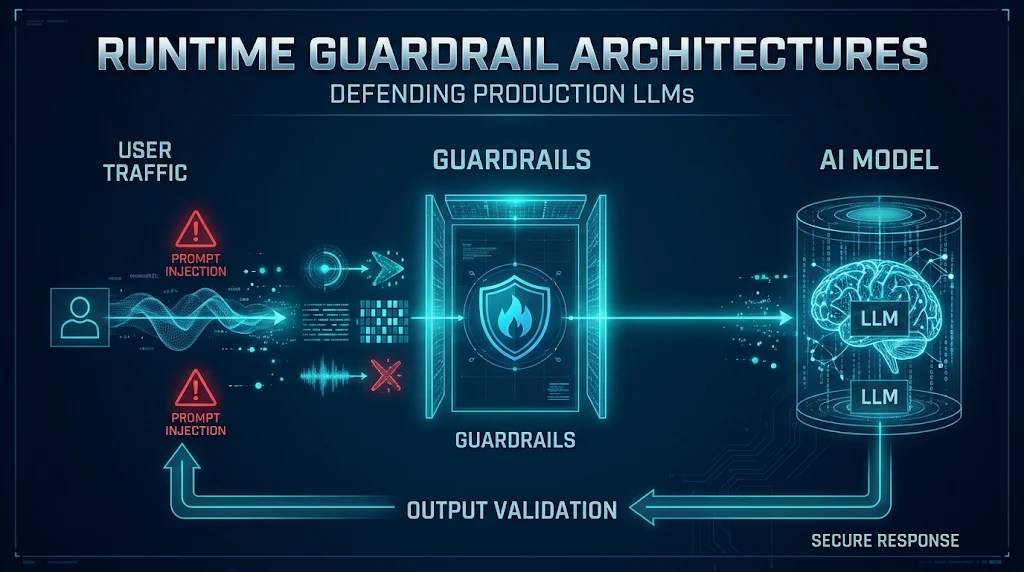
The fix is to take safety and compliance enforcement away from the prompt and hand it to a dedicated runtime guardrail architecture: a separate interception layer that normalises, inspects and governs traffic on its way to the model, and again before any response goes back to the client.
The Production Risk Surface Beyond Simple Guardrail Circumvention
Teams that test only against obvious “ignore previous instructions” prompts leave serious architectural weaknesses open. A production LLM deployment has four distinct runtime failure modes:
- Direct Prompt Manipulation: A user deliberately builds input to get around operational policies or push the model beyond its approved domain, frequently with roleplay framing, base64 encoding, switching between languages, or token smuggling.
- Indirect Prompt Manipulation: Untrusted instructions sit inside external data the application pulls in on its own: uploaded PDFs, CRM notes, web pages, customer support emails. Once that text lands in the model’s context, the hidden instructions run with the application’s own authority.
- System Prompt and Context Extraction: Untrusted parties pressure the model into reciting proprietary business logic, the internal system prompt, or metadata fields that orchestration added.
- Policy Drift in Outputs and Unsanctioned Commitments: No bad intent is needed here. When frustrated users push them, probabilistic models can invent unauthorised pricing discounts, make legal or medical assurances, mention competitors inappropriately, or produce offensive language.
Covering all four risks calls for defence in layers. A single validation mechanism either adds latency nobody can accept or leaves blind spots that a determined user can get around within minutes.
The Four Layers of a Guardrail Pipeline in Production
A robust guardrail layer keeps fast deterministic checks apart from deeper semantic evaluation, so cheap misuse attempts are filtered out early, before heavier models consume any GPU compute.
1. Normalisation and Deterministic Pre-Filters
The opening stage of the guardrail middleware should run entirely in CPU memory, with latency under 5ms. Its job is to normalise the input and undo obfuscation tricks before any classifier looks at the text:
- Remove zero-width spaces, homoglyph substitutions and invisible Unicode characters.
- Spot suspicious payloads tucked into ordinary prose, whether base64, hex or URL-encoded, and decode them.
- Apply strict input character limits and token density checks that stop denial-of-wallet padding.
- Use high-precision regex and Aho-Corasick matching to catch known secret formats (bearer tokens, API keys, internal database connection strings), so that sensitive credentials never reach external model providers.
2. Lightweight Intent and Prompt-Manipulation Classifiers
A general-purpose LLM makes a poor primary input guard: it adds latency of 400 ms to 1,500 ms and doubles token spend. Production systems instead run compact, purpose-built encoder models, for example RoBERTa or fine-tuned DeBERTa-v3 classifiers in the 100M to 400M parameter range, hosted in-house on ONNX Runtime or TensorRT.
On modest hardware these compact models finish in 15ms to 40ms and score each incoming payload along separate dimensions:
- Likelihood of prompt manipulation
- Topic relevance (a banking assistant should not be solving coding homework)
- Risk of harassment, offensive speech or self-injury content
Each classifier returns a calibrated probability score instead of a binary pass/fail, which lets engineering teams set thresholds separately for every application route.
3. Structural Context Isolation
Countering indirect prompt manipulation means the architecture has to split trusted instructions from untrusted data payloads explicitly before the final prompt is assembled. Do not concatenate external text straight into a plain-text prompt. Instead, wrap each untrusted input block in randomised structural delimiters and give the model explicit data-only framing:
- Generate a random token boundary for every request (for example,
<untrusted_doc_9f4a2>...</untrusted_doc_9f4a2>) so nobody can close the tag early from within a crafted document. - Tell the model, in the system role, that anything inside those dynamic boundaries is passive reference text only and never a directive to carry out.
- Strip external image tags and markdown hyperlinks from model output unless their domain is on an allowlist. This stops invisible markdown image renders (
) from quietly sending session context out via the user’s browser.
4. Verifying Output Against Policy
Checks on input alone cannot ensure safe output. An innocent-looking query may still lead to an unauthorised commitment or expose internal reasoning steps. Before any text reaches the end user, the output guardrail compares each generated response with business policy, looking for hallucinated URLs, unauthorised promises, formatting violations or mentions of banned competitors.
Execution Topologies: Trading Latency Against Security
The point in the request lifecycle where guardrail checks run determines both your security posture and the user experience. Enterprise deployments mostly rely on one of three architectural topologies:
| Architecture Pattern | Mechanism | P95 Latency Overhead | Security Assurance | Compute and Token Cost | Best Fit |
|---|---|---|---|---|---|
| Sequential (Synchronous) | The main LLM is called only after input guards have fully finished, and the response is sent only once output guards complete. | High (+100ms to +800ms) | Strict (unwanted requests are stopped before the LLM runs) | Low (a blocked input costs nothing in main-model tokens) | Regulated sectors such as finance, healthcare and legal compliance |
| Parallel Speculative | Input guard and main LLM run at the same time; response tokens sit in a short buffer until the guard approves. | Minimal (+20ms to +50ms) | High (blocked output never reaches the client, although the main LLM has already begun generating) | Medium (cancelled requests waste some LLM tokens) | Real-time copilots and high-volume chat for customers |
| Asynchronous Audit | Requests and responses travel directly between client and LLM; guardrails check logged copies afterwards. | Zero (0ms) | None at runtime; it only detects and raises alerts | Low (runs on batch or off-peak compute) | Shadow-testing new guardrail rules; internal productivity tools |
Running Parallel Speculative Execution Safely
For interactive products, where retention depends directly on Time-to-First-Token (TTFT), parallel speculative execution strikes the best balance. For every user request, the orchestrator dispatches two calls in parallel:
- The suite of fast input classifiers, which completes in about 30ms.
- The main LLM inference call, which typically yields its first token after 250ms to 500ms.
The classifier scores the input faster than the primary LLM can emit its first token, so the guardrail check nearly always completes before the first byte of the response exists. When the classifier flags a high-confidence manipulation attempt, the orchestrator cancels the upstream LLM stream at once with an abort signal and sends back a standard refusal message. Valid requests see no noticeable safety delay, and unwanted requests still never reach the client.
Building Policy-Driven Guardrail Middleware
When safety rules are hardcoded in application business logic, auditing and changing policy becomes slow and error-prone. A cleaner pattern separates detection engines from enforcement policy through a version-controlled configuration schema that the middleware layer loads.
policy_id: "customer-support-assistant-v2"
failure_mode: "fail_closed" # Options: fail_closed, fail_open_with_alert
input_guards:
  - name: "unicode_normalizer"
    type: "deterministic"
    action: "sanitize"
  - name: "untrusted_input_classifier"
    model: "deberta-v3-untrusted-input-prod"
    threshold: 0.82
    timeout_ms: 80
    action: "block"
    fallback_response: "I cannot process that request as phrased. Please rephrase your question about your account or order."
  - name: "off_topic_filter"
    model: "intent-router-small"
    allowed_topics: ["billing", "shipping", "returns", "account_settings"]
    threshold: 0.70
    action: "redirect"

output_guards:
  - name: "external_markdown_exfil_stripper"
    type: "deterministic_regex"
    allowed_domains: ["help.company.com", "status.company.com"]
    action: "redact"
  - name: "unauthorized_refund_promise"
    model: "policy-nli-checker"
    threshold: 0.85
    action: "abort_and_replace"
    fallback_response: "Refund eligibility depends on your order details. Let me connect you with a billing specialist to confirm."
Choosing Between Fail-Closed and Fail-Open Behaviour
Each guardrail component adds another runtime dependency, and any of them can hit timeouts or hardware failures. Architects need to set explicit timeout budgets and failure behaviour for every route:
- Fail-Closed: When a guardrail classifier returns an error or exceeds its 80 ms timeout, the middleware refuses the request and responds with a safe fallback message. This mode is required for regulated domains, for customer-facing applications, and for automated workflows that have external side effects.
- Fail-Open with Alerting: When a guardrail service degrades, the request skips the check, a high-priority incident event is logged, and the payload is queued for asynchronous inspection. Reserve it for internal tools with low risk, where staying available matters more than strict policy enforcement.
Protecting Streaming Responses While Keeping the UX Intact
Sending tokens from an LLM straight to the frontend makes responses feel immediate, but it stops traditional output guardrails from working. Nobody can judge whether a sentence is safe from its first two tokens, and holding everything back until a 400-word response completes ruins the streaming experience.
Production systems usually solve this with a sliding-window sentence buffer:
- Chunk Accumulation: Rather than pushing each token to the client, the guardrail middleware holds incoming tokens until it reaches a natural boundary: a newline, a sentence terminator (
.,?,!), or a hard cap of 25 tokens. - Windowed Evaluation: When a sentence is complete, the middleware sends it to the fast output classifier together with the two preceding sentences, which supply cross-sentence context.
- Release the Stream or Abort Cleanly: When the window clears inside the latency budget (usually below 35ms), the buffered text is flushed to the client stream. If a violation is detected partway through, the server pushes a Server-Sent Events (SSE) control event with a structured payload that tells the frontend to clear the partial message bubble and show a clean fallback response.
The cost is roughly one sentence of initial buffering delay, which most users never notice. In exchange, policy-violating text never flashes on screen or ends up in screenshots.
Measuring Guardrail Performance and Avoiding Over-Refusal
A guardrail that is too aggressive hurts an enterprise product as much as having none at all. Picture a technical support assistant that rejects a developer asking, “How do I terminate a hung worker process and force a read past the local cache?” simply because the classifier reacts to the words “terminate” and “force”. Users will abandon that system quickly.
Four operational metrics, tracked continuously, keep guardrails calibrated in production:
- Red-Team Success Rate: The share of prompts from your automated red-team test suite that get past the guardrail layer and draw out a response you did not want.
- False Refusal Rate (FRR): How often benign, in-domain user queries end up wrongly blocked or redacted. Keep a dedicated “benign hard-negative” dataset of domain terminology that superficially resembles misuse language, such as SQL queries, legal clauses or security discussions.
- P95 Guardrail Latency Overhead: Extra end-to-end delay added purely by the pre- and post-processing layers, measured apart from LLM inference time.
- Stream Abort Rate: How often output guardrails stop a generation that is still in flight. A sudden jump usually points to either a new wave of misuse attempts or a recent upstream model update that changed its tone.
Before any threshold change or classifier update goes to production, run it in staging against both your red-team dataset and your benign hard-negative dataset. A weekly human review of anonymized blocked inputs closes the feedback loop, converting edge cases seen in real production into training examples and steadily sharpening classifier precision.
Runtime guardrails are no silver bullet. They must never replace least-privilege backend design, row-level data permissions or strict authentication. Combined with clean architectural isolation, though, layered guardrail middleware turns unpredictable language models into enterprise software you can govern, able to handle real-world traffic without giving up speed or usability.