Designing a Scalable LLM Routing Layer for Multi-Model Enterprise AI
Once enterprises move Generative AI beyond isolated pilots and into company-wide use, one architectural constraint shows up fast: depending on a single Large Language Model (LLM). Wrapping an internal application around one proprietary API, such as Anthropic’s Claude 3.5 or OpenAI’s GPT-4, is the simplest starting point, yet for enterprise-grade production it cannot be sustained either functionally or financially.
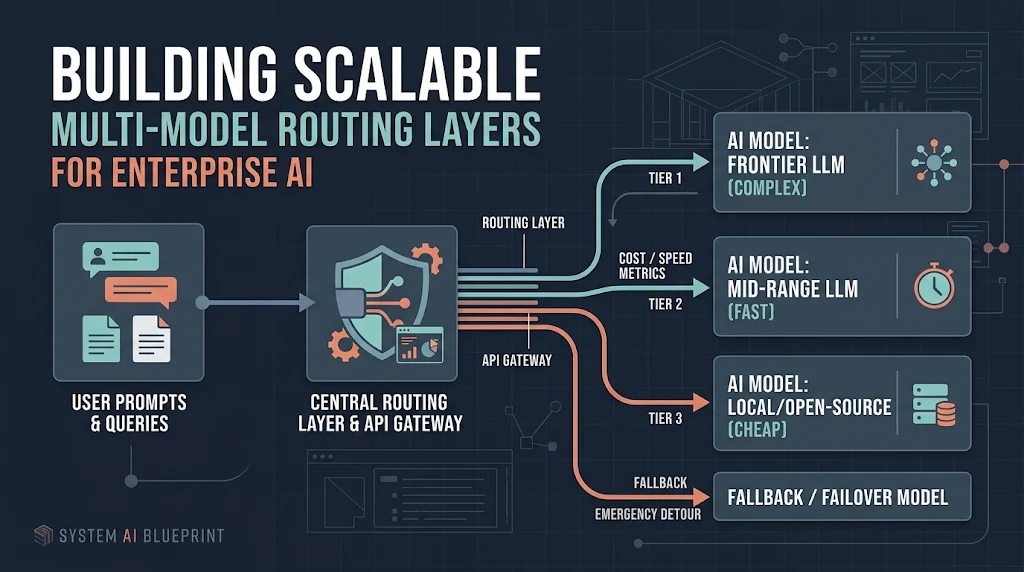
Relying on one model leaves a business open to heavy vendor lock-in, severe single points of failure and very wasteful cloud spending. Current enterprise AI architectures reduce those risks with a Multi-Model Routing Layer, a piece of intelligent middleware placed between end-user applications and the AI models beneath them, assessing each incoming query on the fly and sending it to whichever LLM fits best given task complexity, cost limits, latency targets and live API availability.
A routing layer that scales well combines API gateway management, semantic evaluation and dependable fallback mechanisms in a careful way. The guide below explains how to design, deploy and operate a multi-model orchestration system that runs efficiently.
Where Single-Model Architectures Fall Short
It helps, before getting into routing design, to see clearly why deployments built on one model break down at enterprise scale. Those failure modes determine exactly which capabilities your multi-model router needs.
Vendor Lock-in and API Rate Limits
A business whose whole tech stack is hardcoded against one vendor’s API schema is in a fragile position. Should that vendor suffer a major outage, alter its pricing, or retire the model version your system depends on, your internal applications stop working. Enterprise traffic also tends to hit API rate limits, measured in Tokens-Per-Minute or Requests-Per-Minute. Running into those caps at the busiest hours of the business day means lost requests and interrupted workflows.
Wasted Spend on Token Processing
Plenty of AI tasks do not need a frontier model’s reasoning power. Calling a huge, expensive model such as GPT-4 for simple classification, text summarization or basic data extraction is like using a supercomputer to add up a grocery bill. With only one model available, you pay top token rates even for trivial work, and the AI budget drains quickly.
Core Building Blocks of a Multi-Model Routing Layer
A solid routing layer is far more than an ordinary load balancer; it acts as an intelligent orchestration engine. Building one that scales means bringing together three core architectural pieces.
The Centralized API Gateway
At the base of the router sits a centralized API gateway, which gives every incoming AI request a standard shape. Applications no longer call OpenAI, Google or local servers on their own; each one sends its requests to your internal gateway through a single shared endpoint (for example, [api.yourcompany.com/v1/chat/completions](https://api.yourcompany.com/v1/chat/completions)). The gateway takes care of authentication, per-team rate limiting and request logging, then forwards the payload for orchestration.
The Prompt Evaluator and Classifier
Think of this component as the routing layer’s brain. It examines the incoming text before any prompt goes to an LLM, using a small, very fast embedding model or a compact classification algorithm to judge how complex the request is. Is this a straightforward summary? A difficult coding problem? A translation across languages? The classifier attaches metadata to the prompt (for instance Task_Type: Summarization, Complexity: Low) that the routing logic then uses.
The Orchestration Engine
With classification done, the orchestration engine carries out the routing decision itself. It matches the prompt’s metadata against the routing rules you have configured, looks at the current health and latency of each connected LLM endpoint, and sends the request to the best-suited model.
Building Intelligent Routing Logic
How well the routing layer performs comes down to the logic behind its decisions. Mature enterprise designs apply three main routing strategies at once.
Complexity-Based Routing
Balancing performance against cost depends most on this logic. Models are grouped by the routing layer into tiers.
- Tier 1 (Frontier Models): Strong reasoning at high cost (for example GPT-4 or Claude 3 Opus). Reserved for strategic analysis, deep reasoning and difficult coding.
- Tier 2 (Mid-Range Models): Quick, with moderate reasoning (for example GPT-4o-mini or Claude 3 Haiku). Handles email drafts, standard RAG queries and customer service replies.
- Tier 3 (Open-Source / Local Models): Very cheap or free and hosted locally (for example Llama 3 8B or Mistral). Covers PII redaction, simple text classification and basic data extraction.
A simple prompt is sent automatically to a Tier 3 model. When the classifier spots a hard logic puzzle, the router passes it to Tier 1, so top-quality output is used only where it is actually needed.
Cost-Based Routing
Firm budget limits can be built into the routing layer. A rule might say, for instance, “Once the IT department has spent more than $500 in tokens today, send every further non-critical request to the free Llama 3 model hosted locally.” Throttling of this kind avoids unexpected bills and keeps service running without large cost overruns.
Latency-Based Routing
In user-facing applications such as real-time chatbots, speed matters more than flawless output. The routing layer pings every available AI endpoint on an ongoing basis to track response times. Whenever the main mid-range model slows down, say with a time-to-first-token above 2 seconds, the router immediately shifts traffic to a quicker alternative so users notice no disruption.
Adding Fallback and Retry Mechanisms
API failures cannot be avoided in a distributed AI system. A dependable multi-model routing layer has to ensure high availability by means of well-designed fallback architectures.
The Circuit Breaker Pattern
Continuing to send traffic to an external API that has gone down leads to cascading failures and application timeouts, so the routing layer needs a circuit breaker. When an LLM endpoint fails three times in a row inside a given time window, the circuit “trips.” The router immediately stops directing traffic there and sends every request to a backup model, chosen in advance, from another vendor. From time to time the circuit breaker sends one test ping to the unavailable API; after confirming the service is back, it closes the circuit and normal traffic resumes.
Graceful Degradation
Token limit errors, such as a 429 Too Many Requests response, call for the router to retry gracefully. Rather than failing, it intercepts the error and immediately sends the identical prompt to a fallback model. To the end user, the application just takes an extra second to answer instead of showing a severe system error.
Keeping Output Schemas Unified
A less obvious difficulty with multi-model architectures is that each LLM formats its output in its own way, particularly when an application asks for structured JSON.
Schema Translation and Normalization
Suppose your internal software depends on a particular JSON format. If a fallback abruptly swaps an OpenAI model for an Anthropic one, it could break the application if the replacement structures its JSON differently. For that reason the routing layer needs an output normalization step. Before returning a response to the application that asked for it, the router parses the LLM’s output, confirms it conforms to the required schema and reformats any mismatches on the fly. This abstraction ensures downstream software keeps working no matter which LLM produced the answer.
Security, Auditing, and Compliance
Sending all AI traffic through one centralized middleware layer brings large security and compliance advantages, which matter greatly for enterprises operating in regulated industries.
Centralized PII Redaction
Ahead of any prompt leaving for an external cloud API, the router can pass it through a small NLP model, hosted locally and built specifically to find and remove Personally Identifiable Information (PII), for example patient names, credit card numbers or social security numbers. That keeps the organization firmly compliant with GDPR and HIPAA without depending on end users to clean up their own prompts.
Usage Telemetry and Billing Attribution
With every request passing through the central router, IT teams can produce extremely detailed telemetry. For each individual query the router records precise token usage, which model was chosen, latency and cost. The enterprise can then adopt chargeback models that bill particular departments, Marketing or HR for example, for the AI they actually use, and can find and fix inefficient system prompts that needlessly drive up token counts.
A Multi-Model Routing Layer turns enterprise AI infrastructure from a brittle single point of failure locked to one vendor into a resilient, economical and highly scalable ecosystem ready to carry the next generation of business software.
Frequently Asked Questions
1. Why adopt a multi-model AI architecture at all?
Above all, it delivers resilience and cost-efficiency. Sending simple work to open-source or lower-cost models and keeping costly frontier models for hard tasks only lets enterprises cut their AI API bills sharply, while also avoiding downtime when a single vendor suffers an outage.
2. In what way does an AI router pick the model for a request?
Before processing, an intelligent router assesses each incoming prompt with lightweight classification algorithms. It looks at the prompt’s length, its complexity and what the task specifically demands (coding versus summarizing, for example), then checks those factors against configured routing rules covering cost limits and latency targets.
3. What happens when the main LLM API becomes unavailable?
A properly designed multi-model routing layer relies on a circuit breaker pattern. It notices the API failure right away and automatically sends the prompt to a fallback model from another vendor (switching from OpenAI to Anthropic, for instance), so the end-user application keeps running without interruption.
4. Is a multi-model router necessary if I only run local, open-source models?
Yes. Even in a fully air-gapped setup with open-source models on internal servers, you still need a routing layer for load balancing. It spreads incoming requests over several GPU clusters and assigns tasks to local models of different sizes (such as Llama 3 70B for complex reasoning and Llama 3 8B for quick tasks) to make the best use of the hardware.