Designing Real-Time Streaming Pipelines with Apache Kafka and Spark
How quickly a company can take in data and act on it often decides whether it leads its market or falls behind rivals. End-of-day batch jobs are no longer enough to support important business decisions. People now expect an immediate response, whether that is a suspicious-payment alert on a credit card purchase, a personalized product suggestion in an online store or surge pricing in a ride-hailing app. That change in expectations has pushed real-time data streaming architectures to the center of enterprise engineering.
Many of these dependable, high-throughput streaming systems are built on two major open-source projects: Apache Kafka and Apache Spark. Combined, they form a scalable, resilient and very fast data pipeline that can process millions of events every second. Kafka serves as the message broker and buffer, taking in and storing huge volumes of streaming data reliably. Spark is the analytical engine that reads that data in real time, applies complex transformations and passes the results to downstream systems.
This guide walks through what it takes to build real-time streaming architectures with Kafka and Spark. It covers how each one works on its own, why they pair so well for enterprise data pipelines, and which practices to follow when running them in production.
Why Real-Time Streaming Is Important Now
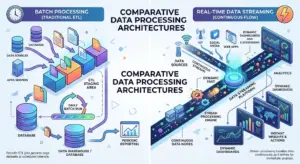
Before looking at the technical details, it helps to understand the business needs behind the move to real-time streaming. Conventional data architectures depend on batch workflows, typically ETL (Extract, Transform, Load) pipelines scheduled for nightly or other fixed intervals. That suits historical reporting, but it falls far short for operational scenarios that need an immediate response.
Streaming reverses that model. Rather than asking a static database what happened yesterday, a streaming architecture handles data continuously, as soon as it is produced, which gives organizations operational intelligence. In finance, for instance, algorithms have to examine transaction streams within milliseconds to spot unusual patterns that point to payment risk. In supply chain operations, IoT sensors on delivery trucks send a steady flow of temperature and location readings, so dispatchers can reroute vehicles as traffic changes or as equipment failures become likely.
User experiences also depend more and more on real-time context. Streaming systems drive live gaming leaderboards, instant stock-level updates during flash sales and targeted ads that show up moments after someone searches for a particular product. Cutting the delay between when data is created and when it is used lets companies open up new sources of revenue and raise customer satisfaction considerably.
Apache Kafka: The Foundation of a Streaming Platform
A dependable real-time architecture needs a system that can take in continuous data from thousands of different sources without dropping a single message. Apache Kafka is built for exactly this. First created at LinkedIn, it is a distributed event streaming platform that can handle trillions of events per day.
Kafka follows a publish-subscribe (pub-sub) model, yet it works very differently from classic message queues such as RabbitMQ. Data in Kafka is grouped into “topics,” which are categorized message feeds. Producers, the applications that create data, publish messages to topics, and consumers, the applications that process data, subscribe to them.
What sets Kafka apart is the way it stores data. A typical message queue removes a message after it is read, whereas Kafka keeps messages on disk for a retention period you can configure. Because of this persistent, distributed log, several consumers can read the same data stream at their own pace without getting in each other’s way. When a consumer fails, it just restarts and continues from the last position it recorded, known as its offset.
Kafka also scales enormously through partitioning. One topic can be spread over several servers (brokers) in a cluster, so reads and writes happen in parallel. This distribution provides fault tolerance as well: when a broker goes offline, copies of its data on the other brokers keep the system running smoothly with no data loss.
Apache Spark: The Engine That Processes the Data
Kafka is excellent at taking in and retaining data, but it was not built for heavy data processing. That is the role Apache Spark plays. Spark is a unified analytics engine for processing data at large scale, and thanks to in-memory computation it can outpace Hadoop MapReduce by as much as 100 times.
For real-time systems, the key part of Spark is its “Structured Streaming” module. It lets developers express streaming queries exactly as they would batch queries, with Spark SQL or DataFrames. The engine then runs those queries continuously and incrementally as fresh data lands in Kafka.
Internally, Spark relies on micro-batching. Rather than handling events one by one, it collects incoming data into small batches, often every few milliseconds, and treats each one as a resilient distributed dataset (RDD). Strictly speaking this adds a very small amount of latency, but throughput is extremely high, which makes the approach a good fit for most enterprise workloads.
Spark provides extensive APIs in Python, Java, Scala and R, so data engineers and data scientists can readily run complex aggregations, transformations and windowing operations, and can even plug machine learning models straight into the live data flow.
How Kafka and Spark Fit Together (The Architecture)
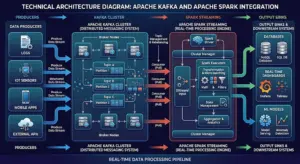
Connecting Kafka and Spark produces a complete pipeline, from source to sink, that is both very powerful and highly resilient. A typical enterprise design moves through three stages: ingestion, processing, and serving/storage.
- Ingestion (the entry point): Producers can be many kinds of source, such as mobile app telemetry, web server logs, IoT sensors or relational databases connected through Change Data Capture (CDC). They send raw events continuously into dedicated Kafka topics. Kafka takes the brunt of the high-velocity traffic, buffering it so that sudden spikes do not swamp the consumers behind it.
- Processing (the brain): An application built on Spark Structured Streaming keeps polling the Kafka topics for new messages and transforms the data as soon as it arrives. That might mean cleaning records, parsing JSON payloads, aggregating metrics over tumbling time windows or joining the live stream with static reference tables (one example is enriching a streamed user ID with demographic details pulled from a database).
- Serving and storage (the action): When Spark completes a micro-batch, it writes the refined data to a chosen sink. Depending on the need, that sink might be another Kafka topic that triggers downstream microservices, a NoSQL store such as MongoDB or Cassandra that supports fast dashboard queries, or a cloud data warehouse such as BigQuery or Snowflake for longer-term analysis.
Because the layers are decoupled, ingestion (Kafka) and processing (Spark) scale separately. When data volume jumps, you add Kafka brokers; when the processing logic grows more demanding, you add Spark worker nodes.
Main Challenges and Best Practices for Production
Running a Kafka and Spark architecture in production comes with obstacles. Real-world streams bring problems such as data that arrives late, state that must be managed and tight consistency requirements.
A major difficulty is reaching “Exactly-Once Semantics” (EOS). Network failures in distributed systems can lead to the same message being delivered more than once, and in a financial application, handling one transaction twice is a serious error. Current releases of Kafka and Spark Streaming support EOS, which ensures each record is processed one time only, even when worker nodes fail. Turning it on means configuring Kafka’s transactional APIs and Spark’s checkpointing with care.
Observability and monitoring matter just as much. Streaming pipelines never stop, so a failure nobody notices can build up a huge backlog of data. Teams need solid monitoring with tools such as Prometheus and Grafana. Important metrics include Kafka consumer lag (how far Spark trails the newest Kafka message), the time Spark takes to process each batch and garbage collection on worker nodes. When batch processing time regularly runs longer than the micro-batch interval, the pipeline becomes unstable.
Finally, schema management is essential. Applications change over time, and so does the shape of the data they emit. Running a schema registry such as Confluent Schema Registry next to Kafka keeps producers and consumers in agreement on the data format, which is often Avro or Protobuf. It stops code changes upstream from quietly breaking Spark jobs downstream.
Conclusion
Together, Apache Kafka and Apache Spark offer a widely adopted blueprint for the toughest problems in real-time data engineering. Kafka contributes outstanding durability and high-throughput ingestion, and Spark supplies the computing power and expressive APIs needed to turn raw streams into insight teams can act on. Teams that learn both technologies well, and understand how each one supports the other, can build scalable, resilient architectures that support coming generations of real-time business applications.
Frequently Asked Questions
Q1: When should I choose Spark Streaming with Kafka over Kafka Streams?
Kafka Streams is a capable, lightweight library that is native to the Kafka ecosystem, which makes it a good choice for microservices and straightforward transformations. Spark is the better option for heavy, complex analytics, for machine learning integration, or for joining streams with large external datasets from other sources. Spark also works with several languages (Python, R, Scala, Java), while Kafka Streams supports only Java and Scala.
Q2: Is Spark Streaming genuinely real-time?
Spark Structured Streaming mainly relies on micro-batching, which adds a little latency, usually in the range of tens to hundreds of milliseconds. That still counts as “real-time” for 99% of business scenarios. If you need latency below a millisecond (true continuous processing), consider Spark’s Continuous Processing mode or other engines such as Apache Flink.
Q3: How does Kafka avoid losing data?
Kafka stays durable by copying data to several brokers in the cluster. A message from a producer is first written to a leader partition and then replicated to follower partitions. When the leader broker fails, a follower takes its place automatically, so committed messages are never lost.
Q4: Why does Kafka consumer lag matter, and what is it?
Consumer lag is the gap between the newest message written to a Kafka topic and the last one the consumer, here Spark, has processed. Watching this metric is essential: lag that keeps growing means the processing engine is falling behind the ingestion rate, so you need to make your processing logic more efficient or add capacity to the Spark cluster.
Q5: Can this architecture run in the cloud?
Yes. Cloud platforms support both Kafka and Spark extensively. You can deploy them on Kubernetes, or choose managed offerings, for example Amazon MSK or Confluent Cloud for Kafka and Amazon EMR or Databricks for Spark. Managed services greatly lower the effort of operating the infrastructure underneath.
Sources & References
- Official Apache Kafka documentation: in-depth guides covering brokers, topics, overall architecture and the transactional APIs (kafka.apache.org)
- Structured Streaming guide for Apache Spark: technical reference on DataFrames, RDDs and micro-batching (spark.apache.org)
- Confluent resources: enterprise streaming use cases and guidance on implementing Schema Registry (confluent.io)
- Databricks Engineering Blog: detailed articles on tuning Spark jobs and on exactly-once semantics in the cloud (databricks.com)