Building Automated Document Chunking and Embedding Pipelines for RAG
Retrieval-Augmented Generation (RAG) and Large Language Models (LLMs) have spread quickly, and they have changed the way organizations work with what they know. Still, a RAG system or a semantic search tool can only be as good as the data pipelines feeding it. If you dump thousands of unprocessed PDFs, Word files and Markdown documents straight into a vector database, you should expect poor retrieval and model answers that do not hang together.
An application that relies on its knowledge base and actually delivers needs a pipeline that is automated and scalable, one that ingests, parses, chunks and embeds documents in a way that is repeatable and recovers from errors.
Getting that design right takes judgment as well as engineering. You have to weigh system architecture, data structure, cost and natural language processing against one another. This article walks through the engineering practices for designing, building and automating chunking and embedding pipelines that hold up in production.
1. How an Automated Ingestion Pipeline Is Put Together
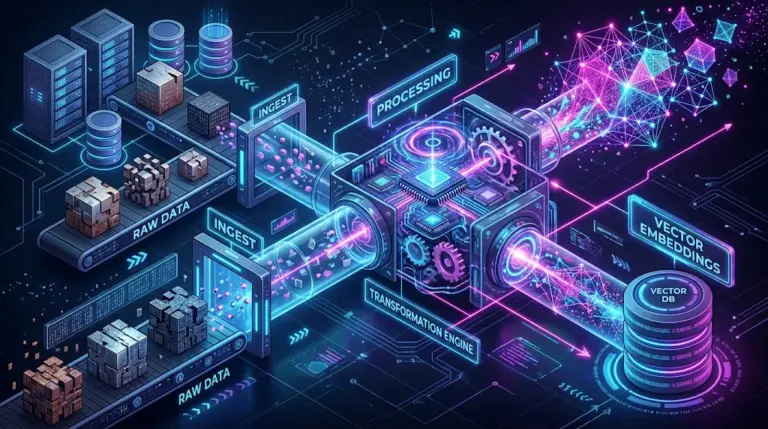
Fundamentally, an automated ingestion pipeline works like a production line: raw, unstructured files go in one end and come out the other as rich mathematical vectors you can query. The work happens in four separate stages:
[ Raw Document ] ──► [ Parsing & Extraction ] ──► [ Chunking & Enrichment ] ──► [ Embedding ] ──► [ Vector DB ]
Doing this at scale calls for an architecture that is asynchronous and driven by events. Suppose someone uploads a PDF into a storage bucket such as AWS S3 or Google Cloud Storage. That upload fires an event trigger, which places a message on a queue (RabbitMQ, AWS SQS or Kafka, for instance). A pool of workers then picks the message up and processes the document.
Separating ingestion from processing keeps large document batches from overwhelming your application, which keeps availability high and makes the system tolerant of faults.
2. Parsing: Bringing Order to Messy Document Formats
Parsing is the first real hurdle. Source documents are almost never tidy text files; they arrive as scanned PDFs, deeply nested Word files, PowerPoint decks and complicated HTML.
The pipeline has to pull out readable text without losing the structural context around it. These are the approaches and tools that enterprise pipelines rely on most often:
- PDFs (the most difficult format): A PDF exists to be displayed, not to be read for meaning. It frequently mixes multi-column layouts, embedded tables, images and headers. Common libraries such as
PyPDForpdfplumberhandle plain text well, while more capable pipelines turn to Tesseract and other OCR (Optical Character Recognition) tools or to advanced engines such asUnstructured.ioandLlamaParseto recover layout and table structure. - Structured markup (HTML, Markdown): These formats are far simpler. Headers (
<h1>,##) and bullet lists already mark natural boundaries. Beautiful Soup or a dedicated Markdown parser lets the pipeline judge how important a block of text is from its position in the document hierarchy. - Rich Office documents (DOCX, PPTX): Libraries such as
python-docxwalk paragraph and table elements directly, so the logical order of the text survives.
Capture Metadata at the Start
Parsing is also the moment to extract metadata and attach it. Recording the author, file name, creation date, page number and section heading while you extract text is essential. Later, this metadata travels with each vector chunk, so search applications can narrow results to particular files or categories before a vector search even runs.
3. Chunking as a Craft: Locating the Semantic “Sweet Spot”
An embedding model built on transformers cannot take in a whole 100-page document in one pass. And even where the context window would permit it, embedding very large blocks of text smooths over their semantic detail and dilutes the precise facts you will later want to retrieve.
Going the other way and splitting too finely, say word by word or sentence by sentence, means losing the surrounding context that gives a piece of information its meaning. Good chunking aims for the “sweet spot” in which every block is coherent in meaning and stands on its own.
Widely Used Chunking Strategies
A. Fixed-Size Chunking
This is the most basic method. The text is divided into a fixed count of characters or tokens (500 tokens, for example) with a set overlap between neighbours (for example, 50 tokens).
- Pros: Very simple to build, and fast to compute.
- Cons: Text is cut in the middle of sentences or paragraphs, which often separates a subject from the context it depends on.
- Rule of thumb: With this method, overlap is not optional; aim for 10-20% of the chunk size. It keeps information that lands on a boundary from disappearing into semantic “blind spots.”
B. Recursive Character Chunking
For natural prose this is the usual recommended default. The pipeline first tries to break text at paragraph breaks (\n\n), then at single line breaks (\n), then at spaces, and only as a last resort at individual characters, stopping once the target chunk size is met.
Why it works: It does its best to keep sentences and paragraphs intact, honouring the way the author grouped ideas.
C. Structural/Hierarchical Chunking
Rather than counting characters, this method lets the document’s own hierarchy set the boundaries. Each Markdown section under a header (###) becomes a separate chunk, and in HTML the split points can follow <div> or <section> tags.
Why it works: Processing follows the natural layout of the document. It is a strong choice for technical documentation and for codebases.
D. Semantic Chunking
This newer technique splits text where its meaning shifts. Natural Language Processing (NLP) models or embeddings identify the points at which the topic changes noticeably.
Why it works: Text is grouped by what it means instead of by its visual or structural formatting, although the computational cost is higher.
4. Constructing the Embedding Pipeline
After documents have been broken into coherent chunks, each chunk has to become a dense vector embedding, a numeric array that encodes its meaning.
A key decision for the embedding pipeline is whether to call commercial models through an API (OpenAI’s text-embedding-3-small/large or Cohere’s embedding models, for example) or to host open-source models yourself (such as Hugging Face’s BGE or all-MiniLM-L6-v2, served on GPUs through Triton or Ollama).
| Approach | Performance | Where It Fits Best | Cost Model |
| API-Based (OpenAI/Cohere) | Outstanding accuracy, no infrastructure to run | Fast scale-up, varied natural language requirements | Billed per token (adds up at high volume) |
| Self-Hosted (OSS on GPUs) | Highly customizable, no data leaves your environment | Large-volume pipelines, tight privacy rules | Up-front cost of GPU instances |
Operational Basics for Embedding
- Disciplined batching: Embedding APIs are very sensitive to latency. Rather than submitting chunks one by one, group them (between 100 and 500 per request, for example) to cut network round-trips and raise throughput.
- Handling rate limits: Commercial providers impose firm rate limits measured in tokens per minute. An automated pipeline needs retries with exponential backoff (the
tenacitylibrary in Python is one option) so that HTTP 429 responses are absorbed cleanly. - Dimensions and multiple languages: Confirm that the vector database is configured for exactly the dimensionality the embedding model produces (1536 dimensions for OpenAI’s
text-embedding-3-small, for example). When your documentation spans several languages, choose models trained specifically on multilingual data, such ascohere-multilingual.
5. Loading and Maintaining the Vector Database (the “Upsert” Step)
In the last stage, the vector embeddings and the metadata that goes with them are written into a vector database such as PGVector, Pinecone, Milvus, Qdrant or Weaviate.
True automation means planning for updates and deletions from the outset. Production documents get revised, swapped out and removed all the time. If you only ever append new vectors, the index quickly fills with clutter and searches start returning duplicates.
The Idempotent Ingestion Pattern
The pipeline should run upserts (update or insert) keyed on deterministic IDs.
- Hash the parent document with MD5 or SHA-256.
- Derive a separate sub-ID for every chunk from that file hash plus the chunk’s position in the sequence (for example,
docHash_chunkIndex). - Use the deterministic chunk ID as the primary key when writing. When a document changes, the pipeline recomputes the hashes and the new chunks replace the old ones.
- When a file is removed from the storage bucket altogether, an automated cleanup worker should pick up that event and delete every vector carrying the matching
document_id.
6. Failure Modes Seen in Practice and How to Handle Them
A pipeline looks straightforward in a diagram, but production introduces plenty of disorder. These measures make yours more robust:
- Fragments from badly parsed PDFs: Standard parsers sometimes emit junk chunks made of nothing but a stray punctuation mark or blank lines. Add a cleaning rule that drops any chunk falling below a minimum length or failing a semantic heuristic check.
- Keeping tables readable: Ordinary chunkers tend to tear tables apart, leaving the data meaningless. To avoid that, pull table objects out separately, convert them to Markdown or HTML, and have an inexpensive LLM write a summary of each one. Embed that summary together with the structured markup.
- Adding contextual metadata: A lone chunk taken from page 42 of a company’s annual report stating “operating costs rose by 12%” may be worthless on its own. During chunking, put global metadata in front of the chunk text, for example:
"[File: 2024_Annual_Report.pdf | Section: Financial Summary] Operating costs rose by 12%."Doing so substantially improves how accurately embeddings match.
FAQ Section
Q1: What is the right chunk size for my documents?
It depends on what you are building. Narrow, highly specific retrieval, such as finding one exact figure in a legal or financial document, favours smaller chunks of 150–300 tokens. General question answering, or work that needs narrative context like summarizing a chapter, does better with larger chunks of 500–1000 tokens and generous overlaps of 10–20%. In every case, benchmark retrieval metrics across several chunk configurations to find the balance that suits your system.
Q2: What should I do with images and charts in a document pipeline?
Content that is not text needs multimodal or multi-stage processing. Where the visual context of an image matters, use visual document transformers (for example Unstructured with OCR) or send the images to multimodal models that can see them and return structural descriptions. Those text descriptions can then be handled like any other chunk and embedded next to the original document text.
Q3: How frequently should I re-index and re-embed?
Make indexing event-driven. Whenever a file is created, modified or deleted in your storage systems, the automated ingestion pipeline should update or replace the corresponding data in the vector database right away. A full re-embedding is needed only when you move to a better embedding model, and that is normally handled as a planned, offline database migration.
Q4: Which is better for embeddings, open-source models or API-based ones?
With very large datasets running to billions of tokens, open-source models (BGE, sentence-transformers and similar) on dedicated GPUs can remove per-call API costs and satisfy strict data privacy regulations. For smaller workloads, quick prototypes or applications with varied language requirements, commercial API models give top-tier performance immediately without any infrastructure to manage.
Sources & References
- LangChain & LlamaIndex community documentation: Reference workflows for recursive, structural and semantic text splitters (python.langchain.com)
- Unstructured.io guides for its API: Current methods for pulling structured text and table data out of disorderly PDF and Office files (unstructured.io)
- OpenAI embedding reference: Guidance on batching, rate limiting and handling differences in dimensionality (platform.openai.com)
- Pinecone & Milvus upsert patterns: Architectures for idempotent data streams and for updating metadata dynamically (pinecone.io / milvus.io)