Designing Durable State Management for Long-Running Autonomous AI Workflows
It was 02:14 UTC on a Tuesday when a mid-sized logistics company’s autonomous procurement reconciliation pipeline stalled partway through a batch of 400 international customs declarations. On average, one workflow instance took 42 minutes from start to finish. It pulled line items out of multi-page bills of lading, checked them against international tariff classification schedules, called a rate-limited external customs brokerage API, and then waited for regional compliance officers to approve the result asynchronously.
The team had kept workflow state in an ordinary in-memory Python dictionary while the process waited on callbacks from webhooks. Then an ordinary Kubernetes node autoscaling event evicted the running pods. Replacement containers came up 18 seconds later, but every in-flight execution context was gone. It got worse: before the failure, 114 workflows had already sent the customs brokerage portal non-idempotent POST requests. Rerunning the batch from the start produced duplicate tariff filings, got the corporate API credentials locked for 24 hours, and left four operations analysts spending two days reconciling mismatched state by hand across three databases.
In enterprise agent engineering, no mistake causes more production failures than handling autonomous AI workflows as if they were stateless HTTP request-response cycles. As soon as an agentic system runs longer than thirty seconds, crosses a network boundary, fans out parallel sub-tasks, or stops to wait for human-in-the-loop (HITL) input, its orchestration runtime has to be separated from process memory. Durable long-running workflows depend on a formal state management blueprint with three foundations: immutable checkpoints, deterministic state reducers, and strict idempotency.
What an Enterprise Agent State Object Contains
Simple LLM implementations treat “state” as nothing more than an append-only list of chat messages (role: user, role: assistant, role: tool). That works well enough for conversational chatbots, but for long-running operational workflows an append-only transcript is an anti-pattern. Across a four-hour run with thirty tool calls, raw API payloads and intermediate reasoning pile up in the prompt context. Attention on the variables that matter gets less accurate, and inference cost in tokens rises linearly with each step.
Enterprise blueprints split workflow state into four namespaces, kept strictly apart inside a typed schema:
- Execution Metadata Envelope: Records the deterministic lifecycle of the graph:
workflow_id,thread_id,current_node,step_sequence_number,parent_checkpoint_idandschema_version. - Domain Working Memory (a Structured Scratchpad): A key-value store with strong typing that holds canonical business entities, for instance boolean compliance flags, computed tax variances and validated purchase order numbers. Nodes write to these fields directly, so models further down the graph never have to parse them back out of conversational text.
- Pruned Episodic Buffer: A summary or bounded sliding window of the agent’s most recent reasoning traces, held under a hard token budget (4,096 tokens, for example). It gives the next step its immediate local context without dragging along history from ten steps earlier.
- External Artifact Pointers (Pass-by-Reference): The state object never holds serialized large payloads such as raw HTML scrapes, binary blobs, PDFs of several megabytes, or SQL result sets with 10,000 rows. The tool writes the payload to an object store, and the state schema keeps an immutable URI (
s3://prod-agent-artifacts/tx-9921/manifest.json) together with its SHA-256 checksum.
Persisting State Across Three Tiers: Hot, Warm and Cold
Three requirements pull in different directions: sub-millisecond reads and writes while parallel tools are running, relational queries for human approval queues, and the seven years of immutable retention that financial compliance auditors demand. No single database engine meets all three at once, so production systems use a storage topology with three tiers.
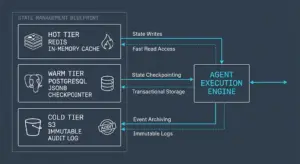
| Tier | Technology | Main Role | Usual Latency | Retention and Durability |
| Hot State Tier | KeyDB or Redis Cluster | Rate-limit counters, distributed locks and live streaming token buffers | < 2 ms |
Short-lived (TTL of 1 to 24 hours) |
| Warm State Tier | DynamoDB or PostgreSQL (JSONB) |
Checkpoints at node boundaries, state diffs, and queries for HITL pause and resume | 5 ms – 15 ms |
ACID transactions, kept 30 to 90 days |
| Cold Audit Tier | GCS or Amazon S3 (Parquet with Object Lock) | Signed trajectory logs, offline RLHF datasets and compliance audits | 100 ms+ |
Write-Once-Read-Many, kept 1 to 7 years |
How the Tiers Work Together
An orchestration worker that pulls work off a message broker (RabbitMQ or Apache Kafka, for example) first takes out a distributed lease lock through the Redlock algorithm with a heartbeat TTL, held in the Hot State Tier (Redis). The lock rules out split-brain execution, in which two worker pods end up handling the same thread_id at once by mistake.
Each time a discrete graph node finishes, the runtime serializes the updated state object and writes it as a transactional row in the Warm State Tier (PostgreSQL). Keeping the state payload in a PostgreSQL JSONB column with a Generalized Inverted Index (GIN) lets engineers run rich operational queries over thousands of paused workflows. One example is finding every workflow where state->>'status' = 'AWAITING_TAX_REVIEW' and state->'domain'->>'vendor_country' = 'DE'.
Last, an asynchronous Change Data Capture (CDC) connector carries committed checkpoints out of PostgreSQL into the Cold Audit Tier (S3). There, finished workflow trajectories are compacted into Apache Parquet files that serve compliance audits and evaluation benchmarks.
Concurrency Control with Deterministic State Reducers
One serious failure mode in multi-agent orchestration shows up during parallel fan-out and fan-in. Imagine a supervisor node that starts three worker agents at the same moment: Agent A calls a CRM API, Agent B consults a cybersecurity risk intelligence feed, and a credit risk model is run by Agent C. Each of the three gets its own copy of the state as of checkpoint T1.
Say Agent A completes after 400ms and replaces the whole state dictionary at T2. Agent B then completes at 650ms and replaces the whole dictionary again with its own edited copy of T1. Agent A’s changes disappear without any error, which is the textbook lost-update anomaly from databases.
To remove these race conditions without forcing parallel branches to run one after another, state management blueprints adopt State Reducers, an idea taken from functional programming and from Conflict-Free Replicated Data Types (CRDTs). Nodes are not allowed to overwrite the root state object. Instead, every field in the state schema names its own merge function:
from typing import Annotated, TypedDict, List, Dict, Any
import operator
from datetime import datetime, timezone

def merge_audit_trail(existing: List[Dict[str, Any]], new_entries: List[Dict[str, Any]]) -> List[Dict[str, Any]]:
    """Idempotent append reducer that deduplicates entries by step_id."""
    seen_ids = {entry["step_id"] for entry in existing}
    merged = list(existing)
    for entry in new_entries:
        if entry["step_id"] not in seen_ids:
            merged.append(entry)
    return merged

def merge_risk_scores(existing: Dict[str, float], updates: Dict[str, float]) -> Dict[str, float]:
    """Deep dictionary merge reducer preserving concurrent key writes."""
    combined = dict(existing)
    combined.update(updates)
    return combined

class EnterpriseOnboardingState(TypedDict):
    thread_id: str
    applicant_entity_id: str
    # Overwrite semantics (only mutated by sequential supervisor nodes)
    current_stage: str
    # Parallel-safe deep dictionary merge reducer
    department_risk_scores: Annotated[Dict[str, float], merge_risk_scores]
    # Parallel-safe idempotent list append reducer
    audit_events: Annotated[List[Dict[str, Any]], merge_audit_trail]
    # Additive counter reducer
    total_tokens_consumed: Annotated[int, operator.add]
When the parallel branches rejoin at the fan-in barrier, the runtime gathers the partial state deltas produced by Agents A, B and C. It then runs the registered reducers atomically inside one PostgreSQL transaction, relying on optimistic concurrency control (UPDATE workflow_checkpoints SET ... WHERE version = expected_version).
Outbox Patterns and Idempotency Keys for External Side Effects
Saving internal memory addresses just half of the reliability problem. Consider a node that performs an external side effect, for example emailing a client, launching an AWS EC2 instance, or charging a corporate credit card. If the worker pod fails after the HTTP request has succeeded but before the PostgreSQL checkpoint is committed, the resumed workflow runs that node a second time and repeats the action.
Enterprise blueprints achieve Exactly-Once Side Effects by pairing deterministic idempotency keys with a local, transactional mutation ledger:
- Generating Deterministic Idempotency Keys: Ahead of any call to an external tool that changes data, the runtime computes a deterministic UUIDv5 hash from the
step_sequence_number, thenode_nameand theworkflow_id:Idempotency-Key = UUIDv5(Namespace, workflow_id || node_name || step_sequence) - Pre-Flight Mutation Ledger: Before anything goes over the network, the tool wrapper looks up that exact idempotency key in a dedicated PostgreSQL table,
tool_execution_ledger. When it finds a row withstatus = 'COMPLETED', it skips the network call altogether and returns theresponse_payloadalready cached in the ledger. - Passing the Key Downstream: When there is no completed row, the wrapper calls the downstream enterprise API and puts the hash in its
Idempotency-KeyHTTP header, which internal microservices, modern ERP gateways, Adyen and Stripe all support natively. It writes the response to the ledger and only then commits the checkpoint.
Time-Travel Debugging, State Forks and Schema Migrations
Sooner or later a long-running workflow hits an edge case: an agent picks a poor route, or an external API sends back corrupted data that is syntactically valid yet contaminates the logic that follows. Since every node transition writes an immutable snapshot that points to its predecessor through parent_checkpoint_id, the states form a Merkle-like directed graph, and that structure gives engineers strong operational recovery tools.
Replaying and Forking State
Suppose step 19 of a 12-hour workflow fails. Instead of hand-editing production databases, an operator can review the checkpoint timeline, load checkpoint_id_17 (the precise state just before the faulty tool call), apply a manual patch to the domain_working_memory JSONB payload, and fork a fresh execution branch. The orchestrator writes checkpoint_id_18_branch_b, sets its parent pointer to checkpoint_id_17, and continues from step 18. The first seventeen steps are not repeated, and the failed branch keeps its historical audit trail untouched.
Coping with Schema Changes While Workflows Are Paused
Workflows that stay asleep for days or even weeks, for example long-cycle contract negotiations or quarterly vendor compliance audits, face a serious operational risk called Schema Drift. Picture 500 workflows sitting in PostgreSQL waiting for a human to sign off externally. Meanwhile the engineering team ships Release v2.4, which changes vendor_tax_id from a string into a nested object and renames it jurisdiction_vat_number.
Three weeks on, a paused v2.3 workflow resumes on the v2.4 codebase, and deserialization fails outright unless the state layer supports Lazy Upcasting:
- Each serialized state snapshot carries an explicit
schema_version: "2.3"header. - The deserializer keeps a registry of pure migration functions, for example
upcast_v2_3_to_v2_4(raw_dict). - While hydrating a checkpoint from PostgreSQL, the runtime compares the snapshot’s
schema_versionwith the application’s current version. If the snapshot is older, the raw JSON dictionary passes through the registered chain of upcasters in memory, one by one, before the TypedDict or Pydantic state object is built.
Frequently Asked Questions
1. Why not keep complete raw API responses and PDF text inside the workflow state database?
Putting payloads of several megabytes straight into Redis state objects or PostgreSQL JSONB leads to heavy write amplification and bloated database memory caches. It also adds CPU cost for serialization and deserialization at every node transition, and it quickly runs into hard payload ceilings such as the 400 KB item limit in DynamoDB. If large payloads live in S3/GCS and the state object holds only small URI pointers plus hash-based fingerprints, checkpoint writes stay below 10 milliseconds.
2. How can workflows that loop hundreds of times avoid memory leaks and context window overflow?
Apply a reducer with two strategies to message and event lists. To begin with, write the full, unabridged event history asynchronously to the audit log in cold storage. Next, set the active state reducer to trigger a Map-Reduce summarization hook or a sliding window whenever the episodic buffer passes a fixed token threshold (6,000 tokens, say). Older finished sub-task traces are condensed into short structured facts, while the system prompt and the most recent N tool interactions are kept unchanged.
3. How does managing state with Temporal.io compare with native graph checkpointers such as LangGraph?
Temporal.io is a durable, deterministic execution engine. Whenever a worker resumes, it rebuilds state by replaying the full event history from the beginning against deterministic workflow code. Native agent graph checkpointers, by contrast, serialize explicit state snapshots at every node boundary and either overwrite or append them. Plenty of enterprise architectures use the two together: Temporal handles durable timers, infrastructure-level retries and microservice orchestration, and graph state schemas inside Temporal activities take care of dynamic LLM routing and context pruning.
4. What should happen to secrets and temporary OAuth tokens when state is checkpointed?
Raw OAuth bearer tokens, session cookies and API keys must never be serialized into Redis or PostgreSQL state checkpoints. When a workflow can pause on one compute pod and resume on another, keep credentials that expire quickly in a dedicated secrets manager (AWS Secrets Manager or HashiCorp Vault, for instance), keyed by workflow_id, and keep only the vault reference path in the state object. Worker nodes retrieve and decrypt the token into volatile memory only for as long as the particular tool call lasts.
5. How can abandoned or parked workflow states be cleaned up without breaking compliance rules?
Set up a state lifecycle job that sweeps the Warm State Tier (PostgreSQL) every night. Any workflow left in PENDING_HUMAN_APPROVAL or ERROR_PARKED past its business SLA (30 days, for instance) moves to a terminal EXPIRED status. Its complete checkpoint history is then checked against the Cold Audit Tier (the S3 Parquet archive). When the hashes match, the warm PostgreSQL rows and hot Redis keys are deleted, freeing costly transactional storage.
Technical Sources and References
- PostgreSQL 17 docs on GIN indexing architecture and JSON types: The official reference on how
JSONBis represented internally in binary, its concurrency semantics, and indexing performance when storing semi-structured state. ([https://www.postgresql.org/docs/current/datatype-json.html](https://www.postgresql.org/docs/current/datatype-json.html)) - Designing Data-Intensive Applications by Martin Kleppmann (O’Reilly): Core distributed systems principles, including snapshot isolation, write-ahead logging (WAL), idempotency in distributed state machines and lost-update anomalies. (
[https://dataintensive.net/](https://dataintensive.net/)) - The Idempotency-Key HTTP Header Field (IETF draft specification): Standard architectural patterns for safe retries that prevent repeated side effects in distributed REST APIs. (
[https://datatracker.ietf.org/doc/html/draft-ietf-httpapi-idempotency-key-header](https://datatracker.ietf.org/doc/html/draft-ietf-httpapi-idempotency-key-header)) - LangGraph: the Persistence and Checkpointer Specification: Reference patterns for thread-level checkpointing, state reducers,
Annotatedschema typing and time-travel forking of state. ([https://langchain-ai.github.io/langgraph/concepts/persistence/](https://langchain-ai.github.io/langgraph/concepts/persistence/)) - Making Retries Safe with Idempotent APIs (AWS Builders’ Library): A production engineering guide covering mutation ledgers, distributed locking and rollback recovery in cloud-native workflows. (
[https://aws.amazon.com/builders-library/making-retries-safe-with-idempotent-APIs/](https://aws.amazon.com/builders-library/making-retries-safe-with-idempotent-APIs/))