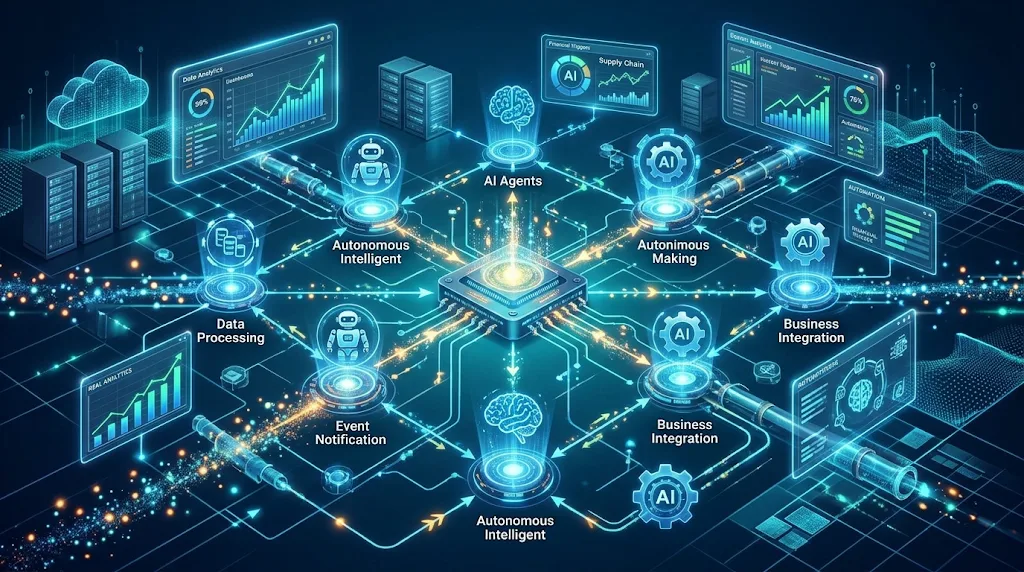
Building Event-Driven AI Agent Systems for Real-Time Business Automation
Business now moves on a timescale of milliseconds rather than hours or minutes. Automation that leans on batch jobs, scheduled cron tasks and rigid polling between APIs struggles to keep up with a real-time economy. Whether the need is spotting suspicious payments the moment they occur, adjusting a supply chain on the fly or tailoring a customer experience to one person, companies want systems that respond, reason and settle each event as it arrives instead of running tasks on a timer.
This is the space that Event-Driven Agent Architectures (EDAA) fill.
The approach combines the reactive, asynchronous style of Event-Driven Architecture (EDA) with the decision-making abilities of AI agents, and it is changing how companies automate multi-step workflows. In place of hard-wired, passive integrations, teams run networks of agents that subscribe to live events, decide what to do with the help of context-aware large language models (LLMs) or rule engines, and coordinate business processes without manual steps.
What follows is a detailed, production-oriented look at how these architectures are built, how they behave, and why they are shaping the next stage of enterprise automation.
1. A Shift to Real Time: Where Conventional Workflows Fall Short
Enterprise automation has long been built as linear, step-by-step orchestration, usually on older Business Process Management (BPM) suites or simple Integration Platform as a Service (iPaaS) products. Such systems are built around request-response cycles in which System A repeatedly asks System B whether anything has changed.
The model works, but once volume grows it exposes several serious weaknesses:
- Latency: Jobs that run on a schedule, such as an inventory sync every 30 minutes, leave gaps. In current markets, information that arrives late is frequently worthless.
- Tight coupling: When System B changes its API or goes offline, System A stops working. The whole process depends on fragile direct links between pairs of systems.
- Poor scalability: Constant polling wastes resources, using up bandwidth and API quotas even when there is nothing new to fetch.
- No adaptive reasoning: Conventional systems follow fixed if/then/else branches and cannot cope with unexpected or unstructured input. Anything outside those rules needs a person to step in, and the process stalls until someone does.
Event-driven agent architectures address each of these problems. Rather than waiting and asking, systems emit “events”, which are notifications that some state has changed (for example, “a customer placed an order” or “a sensor reported overheating”). AI agents pick up these asynchronous events, work out what they mean, coordinate with other agents and respond immediately.
2. Breaking Up the Monolith: What Is an Event-Driven Agent Architecture?
Fundamentally, EDAA is a design pattern that separates what happened from what should be done about it and places autonomous intelligence between the two.
Standard Event-Driven Architecture usually hands an event to a simple, prewritten microservice. An Event-Driven Agent Architecture instead sends the event to AI agents or to a multi-agent system. Those agents can reason: they read the unstructured content of the event, pull context from databases and other endpoints, choose the most suitable response and carry it out through tools such as APIs, webhooks or RPA.
- The event starts things off: A change in business state is published as an event to a broker.
- The agent does the thinking: An autonomous agent, driven by LLMs, machine learning models or complex event processing rules, consumes that event, identifies its intent and decides how to resolve it using current parameters.
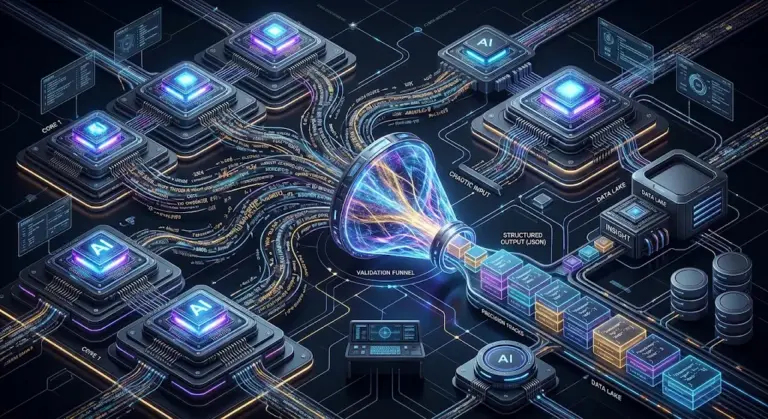
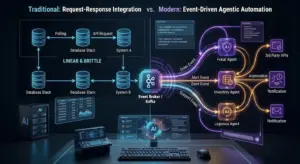
Picturing the Asynchronous Multi-Agent Ecosystem
The diagram below shows how the pieces fit together behind the scenes:
3. The Blueprint: Four Core Layers of an Event-Driven Agent Network
Building an event-driven agent architecture means assembling four foundational layers. Each one has its own job in converting a raw event into a completed automated workflow:
A. Event Producers
Producers are the systems, sensors and user actions that create data. Almost anything qualifies: a CRM record update, an IoT device on a production line, an email from a customer or a flag raised by a payment gateway. A producer only announces that “something happened”; it does not need to know which consumers have subscribed to it.
B. The Event Broker (Ingestion and Routing)
The broker is the backbone of the system. It acts as both a buffer and a traffic controller, taking in thousands of event streams every second and delivering them to whichever consumers have subscribed.
- Common enterprise options: RabbitMQ, Apache Kafka, Apache Pulsar, Amazon EventBridge or Confluent.
- Why the broker matters: It separates producers from agents. When an agent is offline, the broker keeps the events, so nothing is lost and the system tolerates faults.
C. Agentic Middleware (Reasoning and Orchestration Platforms)
At this layer, ordinary events gain intelligence. The middleware handles the lifecycle, memory and coordination of AI agents, using frameworks such as LangChain, CrewAI, AutoGen or LlamaIndex to run agents that work through iterative reasoning loops (for example ReAct, short for Reason and Act).
Sub-agents and specialized roles: Several agents can live inside this layer, for instance a Triage Agent that works out intent, a Data Enricher that retrieves historical records, and an Action Agent that performs the task.
D. Actuators (Tools and Integrations)
An agent needs a way to act on the world. Actuators are the APIs, tools, webhook connectors and Robotic Process Automation (RPA) bots an agent chooses to call in order to take real-time action, such as sending an email through SendGrid, editing a Salesforce record or issuing a Stripe refund.
4. How Autonomous Agents Turn Event Streams into Business Logic
In a conventional event-driven system, an incoming event runs a fixed code path. In an agent-driven design, the event instead passes through a cognitive processing pipeline that looks roughly like this:
[Event Triggered]
       │
       ▼
[Ingestion & Brokerage] (Kafka/EventBridge)
       │
       ▼
[Agent Activation] (Semantic Parse of Event Data)
       │
       ▼
[Context Gathering] (Retrieving customer history, business policies)
       │
       ▼
[Reasoning & Collaborative Planning] (Multi-Agent consensus, if needed)
       │
       ▼
[Execution & Feedback Loop] (API call, RPA, UI updates)
Take the case where a “negative customer review” event is published:
- A Triage Agent recognizes negative sentiment and a high level of urgency.
- An Insight Agent looks up the customer’s purchase history and Lifetime Value (LTV).
- A Negotiation Agent works out a resolution suited to that customer, such as a refund or a dynamically sized compensation voucher.
- An Execution Agent records the outcome in the CRM and sends a personalized recovery email. The whole sequence runs automatically within seconds, yet it stays context-aware and reads as if a person wrote it.
5. High-Value Use Cases in Today’s Businesses
Adopting EDAA can give companies a significant edge in many sectors. Three areas where it is already changing how automation works stand out:
A. Algorithmic Supply Chains and Adaptive Logistics
Conventional supply chains react slowly and often refresh inventory and routing only once a day. With event-driven agents, a disruption event (say, “a storm has delayed a shipment at the port”) sets off a group of cooperating agents:
- A Supplier Agent arranges alternative local fulfillment.
- A Dispatch Agent reroutes delivery trucks as conditions change.
- A Billing Agent estimates the SLA impact and notifies the customer success team.
B. High-Frequency Payment Risk and Security Response
When a transaction raises a “high-risk suspicious payment” event, waiting for a manual review is not an option. An event-driven agent that picks up the event on its own can immediately:
- Check the transaction’s location against recent telemetry from the mobile app.
- Look for matching historical patterns using vector search.
- Lock the account, send an alert, start a temporary review of related customer services and issue a secure conversational verification request, all in less than 2 seconds.
C. Personalization and Real-Time Customer Success
Customers now expect support that responds instantly. When an event such as “user left a high-value shopping cart” arrives, the responsible agent investigates the cause (for example, whether a promo code failed at checkout) and launches an automatic intervention right away, such as an interactive assistant offering help tailored to what the user actually did.
6. Managing Complexity: Challenges, Orchestration vs. Choreography, and Mitigations
For all their strengths, event-driven agent architectures come with obstacles. Building asynchronous systems that keep operations consistent takes deliberate planning:
| Challenge | Impact | Mitigation Strategy |
| Agent loops and hallucinations | Agents may start endless recursive runs or carry out invalid workflows. | Set hard limits and rate limits, and add human-in-the-loop (HITL) checkpoints for high-stakes actions or transactions above a threshold. |
| Data consistency and race conditions | Asynchronous work running in parallel can overwrite data. | Use event sourcing, which stores the history of changes instead of only the current state, and require idempotent APIs so that a task runs once even when it is triggered several times. |
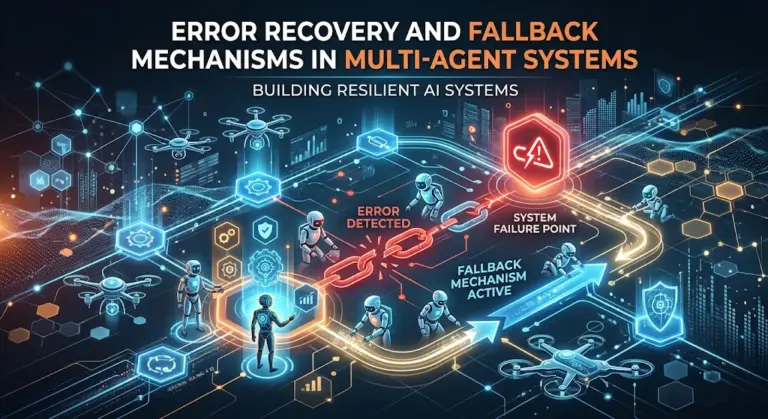
| Observability and tracing | Locating the point where a chain of agents failed is hard. | Adopt distributed tracing tools such as OpenTelemetry and attach correlation IDs to events so paths can be followed across systems. |
Choreography vs. Orchestration: Striking a Balance
- Orchestration: One central “brain” agent directs and oversees every sub-agent. It is simpler to monitor, but the central agent is a potential single point of failure.
- Choreography: Agents work on their own, subscribing to events and emitting new ones with no central coordinator. It scales very well, but it demands firm event governance to prevent tangled “spaghetti workflows.”
Large organizations frequently mix the two: small clusters of agents are tightly orchestrated internally and exchange events with the rest of the company through choreographed brokers.
7. Implementation Roadmap: Best Practices for Moving to Event-Driven Agents
Companies that want to move toward real-time, agent-based automation are more likely to succeed if they proceed in phases:
- Think in events first: Split current business operations into distinct, observable event states. Where a customer touchpoint or a database change does not yet produce an event, make building adapters to capture it a priority.
- Begin with small, non-critical workflows: Target operations that are frequent but low-risk, such as content moderation, ticket triage or operational alerts.
- Give agents strict governance: Make sure LLM-based agents work inside clear guardrails, for example standard operating procedures, narrowly scoped API permissions and limits on cost and tokens.
- Pick tooling built for asynchronous work: Use proven event buses (Apache Kafka, AWS EventBridge) and solid agent frameworks (LangChain, AutoGen, CrewAI) that can interpret and manage asynchronous multi-agent tasks.
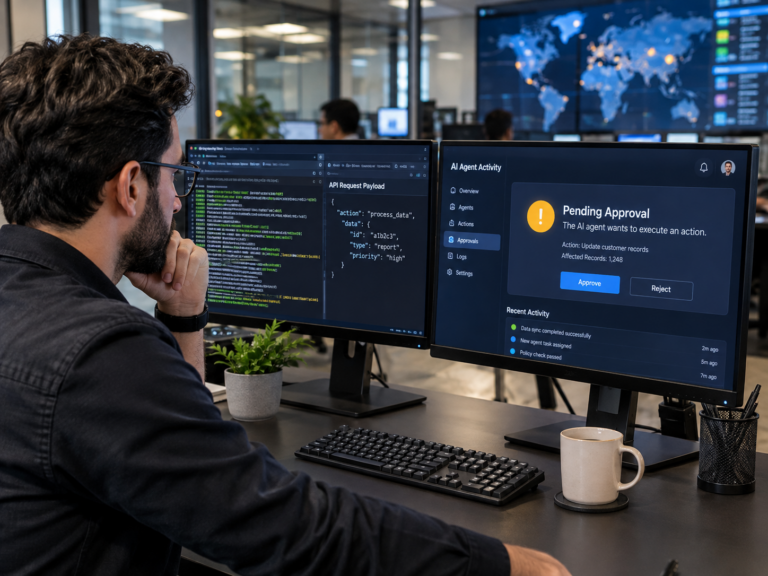
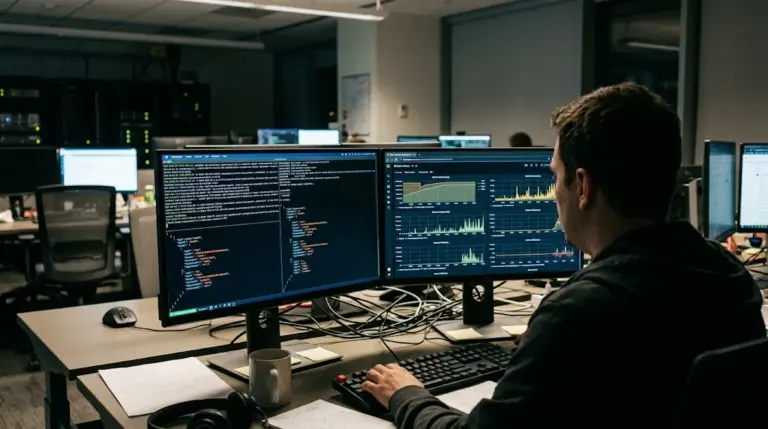
- Build in observability from the start: Log every agent decision path, tool call and action against an event ID. Live dashboards are essential for keeping track of how automated agents are performing.
The organizations that lead will be the ones able to sense, process and act almost instantly. Moving to Event-Driven Agent Architectures lets companies retire batch processing and rigid integrations and make full use of genuine real-time automation.
Frequently Asked Questions
1. How does standard EDA differ from an Event-Driven Agent Architecture (EDAA)?
In standard EDA, events go to static, prewritten functions (AWS Lambda, for example) that run fixed steps. In EDAA, events go to AI agents that rely on cognitive models such as LLMs to assess the context of each event, make judgment calls and change their actions as circumstances require.
2. Which tools work best for building Event-Driven Agent Architectures?
A typical stack combines a broker for events (RabbitMQ, Apache Kafka, Amazon EventBridge), a framework for building agents (LangChain, CrewAI, Microsoft AutoGen, LlamaIndex) and runtime or integration backends (Temporal, FastAPI, Node-RED or an enterprise iPaaS).
3. Does an Event-Driven Agent Architecture have to run in the cloud, or can it run on-premise?
It can run in either place. Many companies use hosted LLMs (OpenAI, Anthropic) together with cloud brokers (Confluent Cloud, AWS), but the full stack can also be deployed on-premise with open-source components such as Apache Kafka and RabbitMQ plus self-hosted models (Llama, Mistral) served through Ollama or vLLM, which keeps data private.
4. How can AI agents be kept from setting off infinite event loops?
The answer is disciplined use of standard engineering patterns: cap the number of agent turns allowed per event, make handlers idempotent, require human-in-the-loop (HITL) approval for certain events, and run real-time anomaly detection on the broker to spot looping behavior.
5. Is EDAA only for large enterprises, or can small businesses use it?
Enterprises gain the most because of their scale and complex data flows, but small and mid-sized companies can still build simpler event-driven automation with lightweight orchestrators such as N8n, CrewAI or Zapier-style event tools, avoiding the heavy infrastructure Kafka requires.
Sources & Further Reading
- Enterprise Integration Patterns by Gregor Hohpe and Bobby Woolf (the standard reference on event-driven systems).
- Designing Data-Intensive Applications by Martin Kleppmann (core ideas on event sourcing and asynchronous messaging).
- Multi-Agent Systems and Collaborative AI Frameworks from OpenAI and Microsoft Research (technical work on how agents cooperate).
- Apache Kafka and Distributed Ingestion Documentation from the Apache Software Foundation.