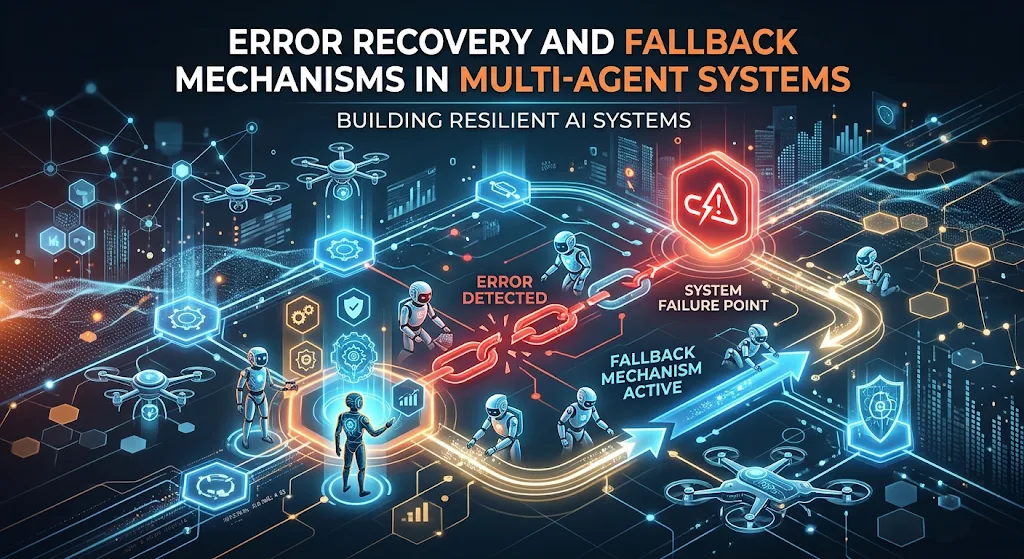
Error Recovery and Fallback Design for Multi-Agent Systems
Putting multi-agent systems into production reveals a basic architectural weakness: state that drifts across distributed components, tool execution failures that cascade, and token hallucinations nobody notices. If one autonomous agent inside a hierarchical or cooperative swarm stalls because of a malformed API response, HTTP 429 rate-limit errors, or JSON output it cannot parse, the whole multi-agent pipeline can fall into a loop that never resolves. Engineering teams building enterprise-grade automation pipelines need the same architectural discipline everywhere to keep operations reliable: clean structural separation, solid error boundaries, and well-defined fallback layers.
This in-depth engineering guide, written with production in mind, looks at designing, building, and monitoring deterministic fallback and error-recovery mechanisms for complex systems of many agents, so that deployments stay fault tolerant under heavy concurrent workloads.
1. How Failures Take Shape in Multi-Agent Topologies
In conventional monolithic microservices, exceptions travel up a synchronous stack trace. Systems built from many agents are different: they run on asynchronous, non-deterministic message-passing topologies. Failures seldom show up as a process suddenly going down; far more often they erode quality quietly through small shifts in behavior.
Typical Failure Vectors
- Schema Drift and Malformed JSON: When language models hand structured JSON payloads to downstream agent tools, they often append markdown blocks, leave quotes unescaped, or omit keys.
- Exhausted Context Windows: Long-running multi-agent tasks that loop through many rounds of tool calls accumulate bloated prompts, which weakens attention and leads to cut-off instructions or recovery states that get forgotten.
- Tool Execution Timeouts: Outside REST APIs, lookups against a vector database, and code interpreter sandboxes all suffer latency spikes, which can leave agent worker threads hanging with no end.
- Endless Reasoning Loops: Faced with unclear error feedback from its environment, an agent can fall into a repeating series of self-correction attempts that consume token budgets while achieving nothing.
- Engineering Principle: In autonomous multi-agent pipelines, expect every external tool call, every LLM inference request, and every message passed between agents to fail or come back malformed once you operate at scale. Build the state machine around anticipated failure, not around the happy path.
2. Architectural Patterns for Resilient Agent Swarms
Self-healing multi-agent workflows that hold up in practice mean leaving simple sequential pipelines behind and borrowing fault-tolerant design patterns from distributed systems engineering.
1. Circuit Breakers in Front of LLM and Tool Endpoints
A circuit breaker keeps an overloaded LLM endpoint or a struggling outside service from spreading failures throughout the agent swarm.
- Closed State: Everything runs normally, and agent requests pass straight through to the main model or tool.
- Open State: Once consecutive failures cross a threshold, such as 5 timeouts or rate-limit violations in a row, the circuit trips and immediately diverts the requests that follow to a fallback handler or a secondary model tier.
- Half-Open State: Every so often, a single test request is allowed through; when it succeeds, the circuit goes back to closed.
2. Fault Isolation with Supervisors and Workers
Put fragile execution steps inside dedicated worker agents that a deterministic supervisor agent watches over. The worker handles high-risk operations, for instance generating Python code dynamically or scraping unstructured web content, and the supervisor serves as a strict state validator that relies on deterministic programmatic checks instead of probabilistic LLM judgments.
[Client Request] --> [Supervisor Agent (State Validator)]
                          |
        +-----------------+-----------------+
        | (Valid State)                     | (Error Detected / Timeout)
        v                                   v
[Primary Worker Agent]            [Fallback Recovery Handler]
        |                                   |
        +---> [Tool Execution] <------------+
3. Building Programmatic Fallbacks and State Rollbacks
Telling an agent in its prompt to “try again if you fail” does not meet enterprise production standards on its own. Recovery has to be enforced in the orchestration runtime layer.
A Code-Level Retry and Fallback Framework
The following production-grade Python pattern pairs circuit-breaking logic and exponential backoff with deterministic fallback models when agent tools run:
import time
import logging
from typing import Callable, Any, Dict

logging.basicConfig(level=logging.INFO)
logger = logging.getLogger("AgentFaultTolerance")

class AgentExecutionException(Exception):
    """Custom exception raised when an agent worker fails all recovery attempts."""
    pass

def execute_with_fallback(
    primary_func: Callable[[], Any],
    fallback_func: Callable[[], Any],
    max_retries: int = 3,
    backoff_factor: float = 2.0
) -> Dict[str, Any]:
    """
    Executes a primary agent operation with exponential backoff and
    switches to a deterministic fallback function upon persistent failure.
    """
    attempt = 0
    while attempt < max_retries:
        try:
            logger.info(f"Executing primary agent task (Attempt {attempt + 1}/{max_retries})...")
            result = primary_func()
            return {"status": "success", "source": "primary", "data": result}
        except Exception as e:
            attempt += 1
            sleep_time = backoff_factor ** attempt
            logger.warning(f"Primary execution failed: {str(e)}. Retrying in {sleep_time}s...")
            time.sleep(sleep_time)

    logger.error("Primary execution exhausted all retries. Triggering fallback handler...")
    try:
        fallback_result = fallback_func()
        return {"status": "success", "source": "fallback", "data": fallback_result}
    except Exception as fallback_error:
        logger.critical(f"Fallback execution also failed: {str(fallback_error)}")
        raise AgentExecutionException(f"Critical failure across primary and fallback paths: {str(fallback_error)}")

# Example usage stub
def primary_agent_call():
    # Simulate flaky API or LLM call
    raise TimeoutError("LLM API endpoint timed out.")

def fallback_static_response():
    return {"output": "Standardized fallback response generated due to upstream service outage."}

# Execution test:
# response = execute_with_fallback(primary_agent_call, fallback_static_response)
4. State Checkpoints and Transactional Memory
If a multi-agent workflow runs for hours or handles thousands of sub-tasks, losing system state partway through wastes compute and leaves downstream databases corrupted.
- Immutable Event Sourcing: Write every message between agents, every tool input, and every tool output as an append-only, immutable log entry in a durable store such as PostgreSQL or Redis.
- Automatic State Checkpoints: Take a snapshot of the shared graph state after each agent turn that succeeds. When a downstream worker hits an exception it cannot recover from, the orchestrator restores the swarm to the most recent verified checkpoint instead of starting over from scratch.
Frequently Asked Questions
1. How does multi-agent error recovery differ from exception handling in traditional software?
Traditional software handles predictable logic with explicit try-catch blocks and deterministic stack traces. Multi-agent systems behave probabilistically, so errors frequently come from semantic misunderstandings, badly formed generations, or non-deterministic tool results, and handling them takes semantic self-correction loops in addition to programmatic retries.
2. How can an agent be kept from looping forever while it tries to fix its own mistakes?
Hard programmatic limits have to be applied at the orchestrator level. These include strict caps on iterations (for example, no more than 3 self-correction attempts), a timeout for each agent turn, and deterministic validation tests that confirm intermediate outputs really conform to the required JSON schemas.
3. Can fallback mechanisms lower output quality without bringing the system down?
They can. Fallbacks commonly swap the best, most tailored generation for safe, standard defaults, such as static templates or smaller and quicker fallback models. Monitoring should treat the rate at which fallbacks are triggered as a key telemetry metric, since it reveals hidden degradation in the primary agent models.
Authoritative Sources & Reference Links
- IEEE Computer Society: Principles of Fault Tolerance in Distributed Systems
- Anthropic Engineering Guidelines: Building Dependable LLM Applications for Production
- Martin Fowler Architecture Catalog: Circuit Breakers and Resilient Microservices
- LangChain & LangGraph Documentation on Fault Tolerance in Production