Automated PII Redaction for Enterprise Data Ingestion Pipelines
Cloud data warehouses and data lakes are built to absorb huge amounts of raw information from hundreds of unrelated sources: server logs, customer support tickets, CRMs and mobile app clickstreams. That open flow of data feeds modern analytics and machine learning, but it also creates a serious compliance and security risk, namely Personally Identifiable Information (PII) arriving in the platform without anyone intending it.
The fallout is severe when sensitive values such as protected health information (PHI), physical addresses, credit card details or Social Security numbers reach a downstream analytics environment. Strict regulations like HIPAA, CCPA and GDPR are violated, developer environments become exposed to data leaks, and the basic trust of the user base is broken.
Cleaning up after the fact, with batch redaction scripts, static database views or manual compliance audits run once data already sits in the lake, is an outdated approach. After PII reaches persistent storage, finding every copy to honour the “right to be forgotten” turns into a forensic ordeal. The one approach that holds up both mathematically and architecturally is to automate PII redaction while data is still in flight, inside the ingestion pipeline itself.
Where Traditional Data Masking Falls Short
In the past, organizations dealt with PII by knowing their schemas. When a database contained a column clearly called customer_ssn, data engineers wrote an ETL (Extract, Transform, Load) script that masked or dropped that column before the data moved on to a reporting environment.
In modern data architectures this method breaks down completely, for several reasons:
- Growth of Unstructured Data: A large share of current data is either semi-structured (JSON payloads) or has no structure at all (chat transcripts, audio transcriptions, free-text fields). A support agent could easily enter “Caller at 555-0198 wants to change the card that ends in 4112” straight into a generic
notesfield, and no schema-level rule would ever notice. - Schema Drift: Upstream microservices change the shape of their payloads all the time. One developer might rename
user_emailtocontact_idwhile it still holds an email address. Unless the downstream ETL job changes at the same moment, that PII goes into the data lake unmasked. - The Gap Before Remediation: Batch jobs run on a timetable. When PII arrives at 9:00 AM but redaction is only scheduled to run at midnight, highly sensitive data sits in plain text for 15 hours, readable by anyone who has query permissions.
The Main Techniques for Automated Data Obfuscation
Engineering teams have to decide how detected PII will be treated before they build the ingestion pipeline. Deleting it outright is usually not an option, because analytics dashboards and machine learning models further downstream often depend on referential integrity to work properly.
Data can be obfuscated in flight in three main ways:
1. Masking and Redaction
This method is the simplest and also the least reversible. The sensitive characters that were found are overwritten with a masking character such as X or *, so [email protected] turns into j***.d**@email.com, for example. Masking suits data that downstream consumers never have a legitimate reason to view in raw form.
2. Secure Tokenization
Tokenization replaces a sensitive data element with a stand-in that carries no sensitivity, called a token. On its own, the token has no outside meaning or value that anyone could take advantage of. The key point is that the link between each original value and its token lives in a token vault that is tightly secured and closely audited.
For analytics this is extremely useful. When an enterprise tokenizes customer emails, analysts can group by the tokenized ID and still follow the behaviour of individual users across many sessions, while never learning who those users really are. A compliance officer who holds the right RBAC (Role-Based Access Control) permissions can “detokenize” the data securely inside the vault.
3. Format-Preserving Encryption (FPE)
Plenty of older downstream systems, rigid BI tools and legacy CRM databases among them, enforce strict schema validation. A system that expects a 16-digit credit card number and gets an alphanumeric token instead simply fails. Format-Preserving Encryption encrypts the value but keeps its original format and length, so a 16-digit number becomes another 16-digit number that cannot be reversed mathematically.
Designing the Detection Engine
At the heart of an automated redaction pipeline sits its detection engine. Spotting an ordinary 16-digit number is trivial, but telling a 9-digit Social Security number apart from a 9-digit corporate routing number takes intelligence.
To keep throughput high, modern ingestion pipelines layer their detection in tiers that balance speed against accuracy.
- Tier 1: Checksums and Regular Expressions (Regex). This layer is the quickest. Regex patterns immediately pick out common formats such as phone numbers, IP addresses and emails. To avoid false positives, such as treating an innocuous product serial number as a credit card, the pipeline also runs checksum checks like the Luhn algorithm, which confirms mathematically that a string is a valid credit card number before it gets flagged.
- Tier 2: Named Entity Recognition (NER). Unstructured text is sent through Natural Language Processing (NLP) models. Tools such as spaCy or Microsoft Presidio look at the context around each word. Given a sentence like “I live in Paris,” the NER model recognizes “Paris” as a location rather than a person, treats it as PII, and redacts it.
- Tier 3: Custom Dictionaries. Enterprises add their own proprietary lists to the detection engine, for instance executive names, internal project codenames, or industry jargon that must stay strictly confidential.
Constructing the In-Flight Redaction Pipeline
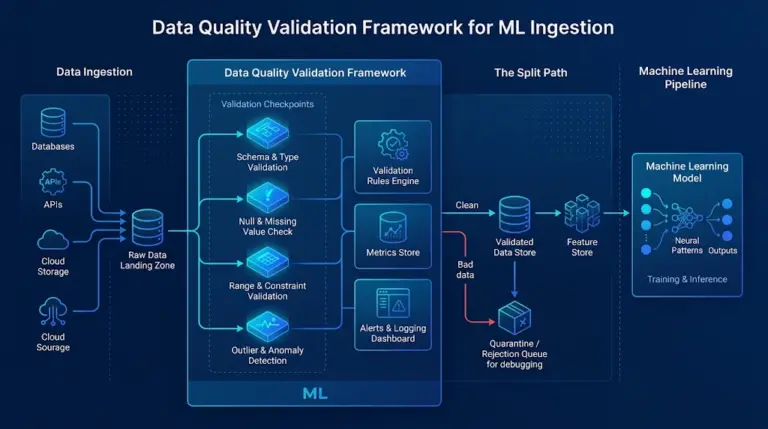
At enterprise scale, the architecture has to process thousands of events every second without adding latency that slows everything down. That calls for a streaming design that is event-driven and loosely coupled.
Step 1: Ingestion Through Message Brokers
Every piece of raw data coming from upstream applications lands first in a message broker built for high availability, for example AWS Kinesis or Apache Kafka, which serves as a buffer. At this point the data is treated as “contaminated” or “quarantined”, and neither data scientists nor analytics tools may read these raw Kafka topics.
Step 2: Processing the Stream
An engine such as Spark Streaming or Apache Flink reads events from the raw Kafka topic as they arrive. Flink fits this job especially well, since it keeps state and handles millions of events with latency below one second.
Step 3: The Redaction Microservice
For each JSON payload it handles, Flink makes an asynchronous call to the Redaction Engine API, which usually runs on Kubernetes so it can auto-scale. The engine scans the payload with the Regex, Checksum and NER tiers. When it finds PII, it applies whichever obfuscation rule has been configured (Tokenization, Masking or FPE) and returns the cleaned payload to Flink.
Step 4: Sending Data to Its Destinations
Flink then inspects the outcome and sends each record to the right place:
- The Gold Topic: Data that is clean, or that was redacted successfully, goes out on a secured Kafka topic further downstream. From there it flows into the enterprise Data Lake, for example Databricks, Snowflake or Amazon S3.
- The Failed-Message Queue: When the NLP engine’s flag on a payload comes with low confidence (it suspects PII but is not certain), or when the tokenization vault API times out, Flink moves the event to a failed-message parking queue. Anything in that queue raises an alert so human data stewards can review it by hand, which keeps doubtful data from ever entering the clean lake.
Optimizing Performance and Governance
Applying machine learning models to every row of ingested data costs a lot of compute. Engineers need aggressive caching so that the redaction pipeline does not turn into a bottleneck. Once the NLP engine has recognized [email protected] and produced a secure token for it, that mapping belongs in a very fast in-memory store such as Redis. The next time Flink sees the same email, it skips the expensive NLP inference and pulls the token straight from Redis, which cuts both pipeline latency and compute spend considerably.
Compliance also involves more than redacting data; you have to be able to show that you did. Each time the pipeline changes a payload, it must write an audit log entry. These logs are kept in a separate, tightly secured index and capture the action taken, the rule that caused the redaction, the source system the data came from and the timestamp. When auditors ask for evidence of GDPR compliance, the logs act as an immutable, hash-chained record of your data governance.
Shifting PII redaction left, out of the data warehouse and into the streaming ingestion layer, removes the risk of sensitive data lying exposed and unnoticed. With this architecture in place, analysts and data scientists can query the data lake freely and intensively, knowing the infrastructure underneath has already neutralized the compliance risks mathematically.
Frequently Asked Questions
Q1: How does static data masking differ from dynamic data masking?
Static Data Masking (SDM) changes the data on disk for good before it is written to a secondary environment, so the original values cannot be recovered from that database. Dynamic Data Masking (DDM) leaves sensitive values unchanged on disk and masks them on the fly whenever a user runs a query, depending on that user’s access privileges. Ingestion pipelines mostly rely on tokenization or static masking, so that the data is physically protected at rest.
Q2: What can be done about false positives, where the NLP model redacts data that was safe?
The way to manage false positives is to adjust the confidence thresholds used by the Named Entity Recognition (NER) models. A model that is only 60% confident a string is a name can send the record to a failed-message queue for review instead of redacting it permanently. Engineers also keep supplying custom “allow-lists” to the detection engine so the model knows to leave specific, safe business terms alone.
Q3: Does Format-Preserving Encryption (FPE) slow databases down?
FPE takes more computation than basic string masking, so it can add a little latency during the encryption step of the ingestion pipeline. Because it keeps the exact data type and length, though (an integer column stays an integer column, for instance), it actually protects read performance downstream, since analytics engines never need to parse complicated tokenized strings or changed data types.
Q4: Which tools work best for automating PII detection in free text?
Microsoft Presidio, an open-source data protection SDK, is among the most capable options for finding and anonymizing PII in text. Other widely used tools include the Google Cloud Data Loss Prevention (DLP) API, AWS Macie (which scans data that is already in S3), and custom spaCy NLP pipelines trained on enterprise-specific datasets.
Q5: Why is redacting data in flight better than redacting it in batches at rest?
Batch redaction leaves a window of exposure. When data arrives raw and is only scheduled for redaction hours later, any unauthorized query or security incident during that window reveals raw PII. In-flight redaction neutralizes sensitive values within milliseconds while they pass through memory (in Apache Kafka or Flink, for example), so they never physically reach a hard drive in an exposed form.