Reducing the Cost of LLM Inference on Cloud GPU Clusters
When Large Language Models (LLMs) go into production, the limiting factor is seldom what the model can do. Engineering teams soon learn that the harder problem is the cost of serving those models at scale. Cloud GPU clusters are a very large operating expense, and an inference pipeline that has not been optimized can use up an infrastructure budget in a matter of days.
LLM inference behaves differently from conventional microservices: it is memory-bound by nature and heavy on computation. Producing even one token means the full set of model weights must be loaded into GPU VRAM, while the sequence context’s KV (Key-Value) cache is also maintained. Once thousands of requests reach the API endpoint, scaling out by simply adding more A100 or H100 instances is not financially sustainable. Bringing inference costs down calls for a detailed strategy that brings together correctly sized hardware, model compression, advanced batching algorithms and changes to the cloud-native architecture.
Below is a thorough plan for designing LLM serving infrastructure on cloud GPU clusters that holds costs down while keeping latency and throughput where they need to be.
Choosing Hardware: Matching VRAM and Compute to the Workload
Over-provisioning is the error teams make most often when they deploy LLMs. The instinct is to pick flagship Nvidia H100 or A100 instances for everything. Those chips deliver exceptional TFLOPS and memory bandwidth, but their premium hourly prices are frequently not justified for smaller models or heavily quantized ones.
For LLM inference, VRAM is the main constraint rather than raw compute. Take a model in the 7-billion parameter class, such as Llama-3-8B: at standard 16-bit precision (FP16) it takes about 16GB of VRAM for the weights alone. Once you allow another 4GB to 8GB for batching overhead and the KV cache, the requirement rises to at least 24GB. That workload does not need an 80GB A100, which can run $3.50 to $4.00 per hour or more on AWS or GCP; it fits easily on one Nvidia L4 or one A10G (each with 24GB VRAM), lowering the hourly instance cost by over 70%.
Bigger models change the picture. A 70B parameter variant needs around 140GB in FP16, which means either two 80GB A100s running Tensor Parallelism or a complex pipeline split across several less expensive GPUs. The practical approach is to take the exact memory needs of your model after quantization and match them to the least expensive GPU setup that offers just enough VRAM and memory bandwidth to hit your Time to First Token (TTFT) target.
Quantizing the Model: Reducing Its Memory Footprint
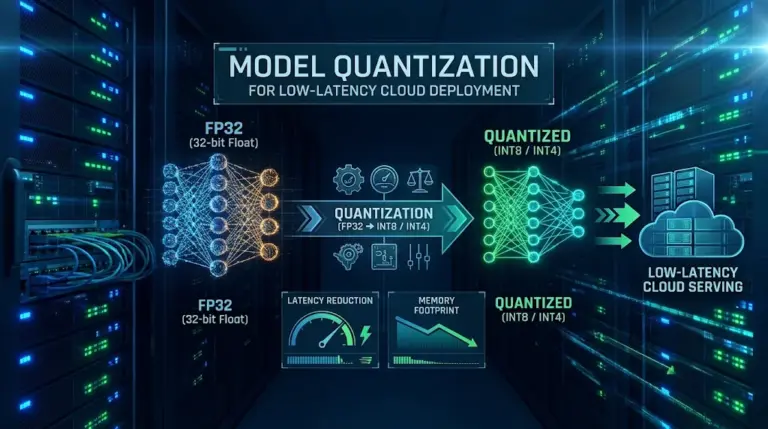
Of all the available levers, quantization does the most to cut both latency and infrastructure spend. Training usually happens in FP16 or BF16. Quantization lowers the precision of the weights, and in some cases the activations, from 16-bit floating point to integers with fewer bits, such as INT8 or INT4.
A 4-bit technique immediately shrinks the VRAM needed to load the model by roughly 75%. A 70B model that used to need 140GB of VRAM can be compressed to about 40GB, so it can run on one A6000 or on part of an A100. That sharp drop in memory footprint turns straight into lower hardware costs.
Standard quantization, however, can hurt reasoning ability and increase model perplexity. Current serving stacks counter this with more advanced algorithms such as GPTQ (Generative Pre-trained Transformer Quantization) and AWQ (Activation-Aware Weight Quantization).
During a short calibration step, AWQ examines how activations are distributed and shields the most “salient” weights, typically about 1% of all weights, by leaving them at higher precision while quantizing everything else aggressively. The model keeps its intelligence yet fits on a far smaller and cheaper GPU. Integer matrix multiplications also run faster on the GPU’s Tensor Cores, which raises throughput and shortens the time the GPU stays busy.
Advanced Batching: Moving Beyond Sequential Processing
Hardware choice and quantization deal with memory footprint; advanced batching deals with throughput. A basic serving setup handles requests one after another or groups them into fixed, static batches. With static batching, the GPU cannot take new requests until every sequence in the current batch has finished. When one prompt needs a 10-token answer and another needs 500 tokens, the GPU capacity serving the shorter request stays idle and expensive compute time is lost.
Production pipelines in large organizations use Continuous Batching, also called in-flight or iteration-level batching, to keep GPUs busy and reduce the cost of each generated token. vLLM and Hugging Face’s Text Generation Inference (TGI) both support it out of the box.
Instead of working per request, continuous batching works per iteration. The moment any request in the batch produces its last token, the system removes it and places a new incoming request into the freed GPU slot. As a result the GPU stays heavily loaded all the time. That high utilization lets each GPU instance handle far more simultaneous users, which directly lowers the number of clusters you have to provision for production.
Handling the KV Cache with PagedAttention
LLMs produce tokens autoregressively during inference. So that attention scores for earlier tokens are not recomputed at each step, the GPU keeps the Key and Value vectors of previous tokens in VRAM; this store is the KV cache. Under high concurrency it can expand without limit, taking up more memory than the model weights and causing out-of-memory (OOM) errors.
In older designs, KV cache memory was reserved as one contiguous block sized for the longest sequence a request could possibly reach. When a user submitted a short prompt, the unused part of that reserved VRAM went to waste, which fragmented memory.
PagedAttention, an algorithm made popular by the vLLM framework, fixes this. Borrowing the idea of paging and virtual memory from classic operating systems, it splits the KV cache into blocks (pages) of fixed size, each holding the keys and values for a set number of tokens. As a sequence lengthens, these blocks are mapped dynamically onto physical VRAM that does not have to be contiguous.
Because internal memory fragmentation disappears, PagedAttention lets the system use close to 100% of available VRAM, and batch sizes can grow by as much as 5x on identical hardware. Fitting five times more requests onto one A100 instance sharply lowers the amortized infrastructure cost of each request.
Cloud-Native Savings: Spot Instances and Auto-Scaling
Apart from the software and model layers, tuning the cloud architecture itself brings large financial returns. GPU compute is very elastic, and traffic to LLM endpoints is almost never even; it rises and falls in clear peaks and troughs over the course of a day.
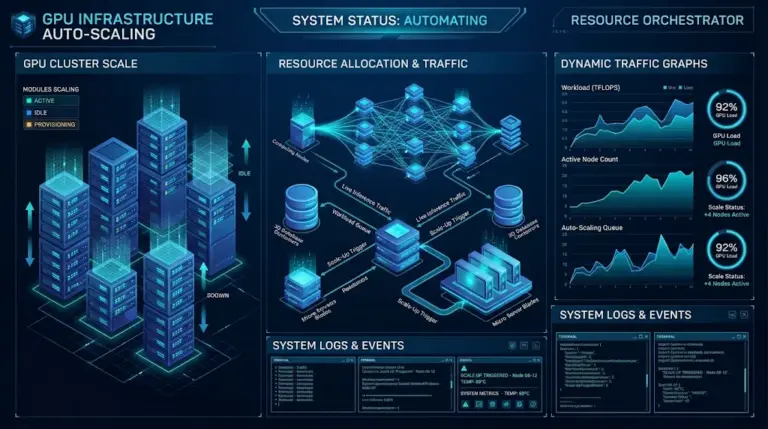
Keeping static GPU clusters running around the clock wastes money. A well-built serving platform should scale horizontally on custom metrics such as the length of the incoming request queue or GPU utilization. New instances come online automatically when traffic surges, and when it eases the cluster shrinks back to a small baseline.
Engineering teams can run asynchronous work, such as background data extraction, offline summarization or batch processing of large datasets, on Spot Instances. AWS, Google Cloud and Azure sell spare GPU capacity this way at 70% to 80% below on-demand prices.
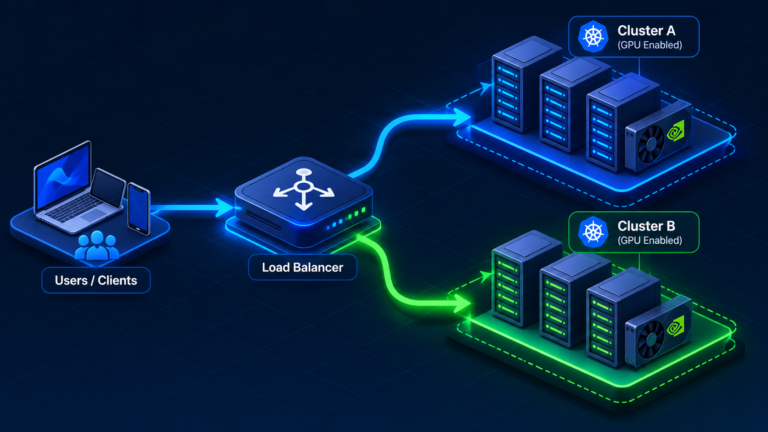
The trade-off is that the provider can preempt (terminate) a spot instance with only a few minutes’ warning. Using them well requires a fault-tolerant serving architecture. In practice that means a load balancer that distributes traffic smoothly across a mixed fleet: on-demand capacity serves real-time traffic that needs low latency, while background jobs go to spot instances. Place a message queue such as Apache Kafka or RabbitMQ ahead of the inference workers; then, when a spot instance is reclaimed its unfinished request goes back onto the queue for a remaining node to pick up.
Serving Many Tenants with LoRA
Companies frequently run several fine-tuned variants of one base model for separate jobs, for example one for SQL generation, one for customer support and one for summarizing medical texts. Giving each fine-tuned model its own GPU cluster leaves hardware badly underused and duplicates costs.
Teams can avoid deploying complete separate models by using LoRA (Low-Rank Adaptation). LoRA produces compact, task-specific “adapter” weights, often only a few megabytes, layered over a base model whose weights stay frozen. Serving frameworks such as vLLM and LoRAX load the large base model into VRAM a single time and then swap the small LoRA adapters in and out of memory for each request as needed.
This makes multi-tenant serving possible: one GPU cluster can serve dozens of specialized fine-tuned models at the same time. Instead of running several huge endpoints, the team manages one shared, well-optimized compute pool, and the infrastructure overhead shrinks accordingly.
Applied together and methodically, these techniques (right-sized hardware, AWQ quantization, continuous batching, PagedAttention and spot instances) let enterprises turn LLM inference from an expense that is hard to justify into a scalable service with predictable costs.
Frequently Asked Questions
1. How do compute-bound and memory-bound AI workloads differ?
A compute-bound workload is held back by the GPU’s raw calculation capacity (TFLOPS). A memory-bound workload is held back by how quickly data, such as model weights, can travel to the processing cores from VRAM. Inference for LLMs is strongly memory-bound, so VRAM bandwidth often matters more than raw compute speed.
2. What impact does 4-bit quantization have on model accuracy?
Current 4-bit methods such as AWQ and GPTQ are built to keep accuracy loss small. In most enterprise scenarios the drop in perplexity or reasoning is negligible, often less than 1-2% on benchmark scores, while VRAM requirements fall by a substantial 3x to 4x.
3. Why not simply use standard static batching for LLM APIs?
Static batching holds new requests until the longest request in the current batch completes. Sequence lengths in text generation differ enormously, so static batching leaves GPU resources unused while short requests wait, which means weaker hardware utilization and a higher cost per token than continuous batching delivers.
4. Is it possible to run a 70B parameter model on one GPU?
Uncompressed at 16-bit precision, a 70B model needs about 140GB of VRAM, so it cannot fit on any single standard GPU, since the A100 and H100 top out at 80GB. With 4-bit quantization the footprint drops to ~40GB, and the model then runs comfortably on one 48GB or 80GB GPU.
5. Can Spot Instances be used safely for production LLM APIs?
Spot instances save a great deal of money but may be preempted at any moment. They are suitable for production when they handle asynchronous workloads that users do not interact with directly, such as backend document processing, and when retries are in place. Real-time chat applications are better served by on-demand capacity or by a hybrid cluster that is managed with care.
Sources & References
- vLLM project documentation (UC Berkeley): the PagedAttention write-up on memory-efficient, fast attention for serving LLMs.
- Hugging Face research: material on Text Generation Inference (TGI) and strategies for optimizing continuous batching.
- Nvidia Technical Blog: guidance on LLM memory requirements and on right-sizing hardware, with the A100 and L4 Tensor Core GPUs as examples.
- Lin, J., et al. (2023), Massachusetts Institute of Technology (MIT): the AWQ paper, which applies activation-aware weight quantization to compress and accelerate LLMs.
- AWS Compute Blog: an article on fault-tolerant architectures that scale AI inference on Amazon EC2 Spot Instances.