Building RAG Systems on Vector Databases for Production Workloads
Retrieval-Augmented Generation (RAG) has become the default architecture for organizations that want Large Language Models (LLMs) to work over their own proprietary data. A rough RAG prototype in a Jupyter notebook needs only a handful of lines, but a RAG system on a vector database that is fit for production needs a solid architectural plan. Leaving a local test setup for a scalable, low-latency production deployment brings hard problems around data ingestion, the accuracy of semantic search, the limits of the context window, and the reliability of the system as a whole.
Enterprise-grade AI operations demand more than plain semantic search. Teams have to design systems that keep data synchronized in real time, use hybrid retrieval, and apply advanced re-ranking. This guide walks through the key components involved in designing, deploying and scaling RAG systems for production use in today’s business settings.
The Core Architecture of RAG
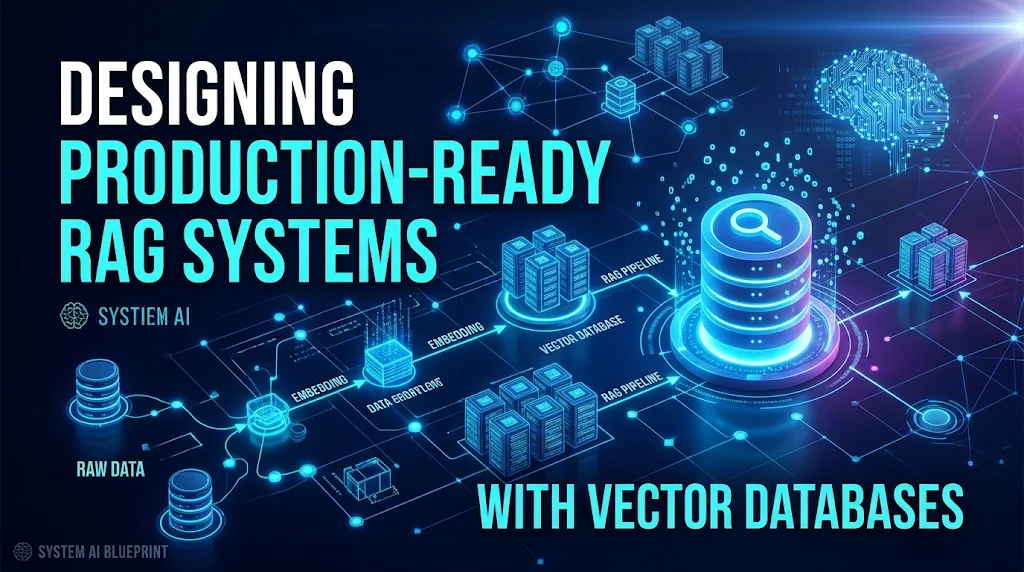
RAG at production grade is never one monolith. It consists of three separate micro-pipelines that cooperate: Ingestion, Retrieval and Generation. Learning to decouple these pipelines and scale each one on its own terms is where building a resilient AI system begins.
The Data Ingestion Pipeline
Ingestion takes raw, unstructured enterprise content, including PDF files, customer support logs, intranet databases and internal wikis, and converts it into a form machines can read. In production this pipeline has to run automatically and cope with incremental updates. Whenever someone drops a new document onto a corporate drive, ingestion should start on its own: it pulls out the text, tidies the metadata and readies the content for embedding, so the LLM is always working from current information.
The Retrieval Pipeline
With the data processed and stored, the retrieval pipeline takes over for incoming user questions. It turns each natural language question into a vector and searches the vector database for the chunks that are closest in meaning. Where accuracy matters most, basic vector similarity on its own falls short, so retrieval also needs metadata filtering and hybrid search to ensure high precision.
The Generation Pipeline
Generation comes last: the retrieved context is joined with the user’s original question and passed to the Large Language Model. At this stage the architecture must assemble prompts dynamically, keeping the supplied context within the model’s token limits and giving clear instructions that discourage hallucination.
Choosing Vector Database Infrastructure
For a RAG system, the vector database acts as long-term memory. Traditional relational databases query structured data with SQL; vector databases, by contrast, are designed to compare high-dimensional vectors by similarity, and to do so at scale.
Standalone Versus Integrated Vector Stores
One early design decision is whether to use a dedicated standalone vector database, such as Pinecone, Milvus or Qdrant, or a vector extension added to a relational database you already run, such as pgvector for PostgreSQL.
Very large applications, where latency is critical and the index holds billions of embeddings, usually favor standalone databases. These offer advanced indexing algorithms such as HNSW (Hierarchical Navigable Small World), which cut search times sharply. On the other hand, an enterprise that already depends heavily on PostgreSQL and wants one source of truth without extra infrastructure to manage will find pgvector an excellent ACID-compliant option that keeps data governance simpler.
Database Capabilities Production Requires
Metadata filtering is a must for any vector database used in production. Suppose an employee asks, “What does our Q3 financial policy say?” The database ought to narrow the search space to documents tagged “Finance” and “Q3” first, and only then run the similarity search. This pattern, called pre-filtering, improves retrieval accuracy considerably and lowers compute overhead.
Tuning the Chunking and Embedding Strategy
In the end, a RAG system can only be as good as the way its data is represented. Badly structured text chunks sent to an embedding model lead the vector database to return irrelevant context, and the LLM’s answers suffer accordingly.
Advanced Chunking Techniques
Chunking means splitting long documents into smaller pieces that are easier to handle. The simplest method chunks by a fixed number of characters, for instance a split every 1,000 characters. That method frequently slices sentences or paragraphs down the middle and loses their meaning.
A production design should use semantic or recursive chunking instead. Semantic chunking follows the document’s own structure and splits at natural breaks: bullet points, markdown headers or paragraphs. Adding overlap between chunks, for example 150 tokens shared by neighboring chunks, also keeps context from disappearing right where a split occurs.
Choosing the Embedding Model
An embedding model converts text chunks into numeric vectors. OpenAI’s text-embedding-3-large is widely used, yet production deployments usually have to weigh cost, latency and data privacy. In heavily regulated sectors, hosting open-source embedding models such as BAAI/bge-large-en on the company’s own servers keeps sensitive corporate data inside the internal network. The architecture should place the embedding service behind an API gateway, so that the embedding model can be replaced later without rebuilding the whole database.
Advanced Retrieval for Production Workloads
Plain semantic search handles broad questions well but has trouble with exact-match keyword queries, such as looking up a particular product SKU or employee ID. Production RAG systems address this with more advanced retrieval designs.
Adding Hybrid Search
Hybrid search pairs dense vector search, which understands meaning and context, with sparse keyword search based on BM25 or TF-IDF. A retrieval layer built to run both at once can cross-check the two result sets. Given a question like “How can I clear error code 404 in the ERP?”, keyword search locks onto “error code 404” while vector search grasps the broader “ERP diagnostics” context.
The Re-Ranking Layer
Pulling the top 20 chunks out of a vector database is quick, but their order does not always reflect true relevance. That is why a re-ranking layer is a key part of production RAG. Once the database hands back a wide set of candidate chunks, a second, smaller machine learning model, for example a Cross-Encoder or Cohere Rerank, scores how directly each chunk relates to the specific question. This step raises the precision of the context placed in the final LLM prompt, cuts noise, and keeps the model from being pulled toward loosely related material.
Context Windows and Prompt Engineering
After the best chunks have been retrieved and re-ranked, the system needs to place that context into the Large Language Model’s prompt in a secure way.
Managing Context Dynamically
Today’s LLMs advertise very large context windows, frequently over 100k tokens, yet leaning on those windows is inefficient and costly from an architectural standpoint. Huge prompts push up both latency and inference spend. A well-built system counts the tokens in the retrieved chunks on the fly and trims them sensibly before calling the LLM API.
System Prompts and Guardrails
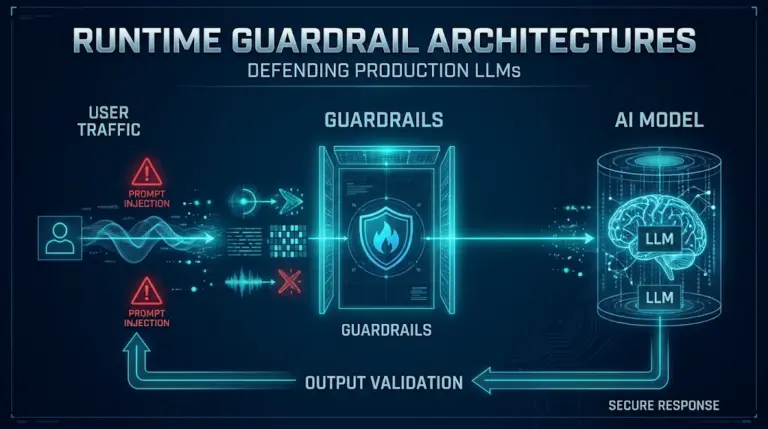
The system prompt sets the operating limits for the LLM. In production RAG, the prompt must tell the model plainly to answer from the supplied context only. A typical enterprise system prompt reads roughly: “You are an AI assistant for the company. Respond to the user’s question using nothing but the context provided. When the context does not explicitly contain the answer, say that you lack enough information to respond.” This safeguard is the most effective way to remove hallucinations when AI is deployed in the enterprise.
Evaluating and Monitoring RAG Pipelines
A RAG system in production behaves like a living thing and needs constant monitoring to stay healthy. Since its pipelines contain several non-deterministic parts, conventional software monitoring does not go far enough.
Telemetry Designed for RAG
Telemetry should be recorded at each stage of the pipeline. Dashboards need to show how long embedding takes, how fast vector search runs, how long LLM inference lasts, and the total API cost of every query. Capturing user feedback as well, even simple thumbs up or thumbs down on answers, supplies the ground-truth data required to keep refining chunking strategies and retrieval settings.
Automated Evaluation Frameworks
To uphold E-E-A-T standards, production teams rely on automated evaluation tools such as RAGAS (Retrieval Augmented Generation Assessment). RAGAS scores a pipeline on several dimensions, among them context precision (did the database surface the correct information?) and factual faithfulness (did the LLM summarize the retrieved context accurately?). Running these evaluations in the CI/CD pipeline makes sure that changes to embedding models or chunking logic never quietly erode system quality.
Building RAG systems on vector databases for production means moving past quick prototypes toward disciplined software engineering. With scalable ingestion pipelines, hybrid retrieval and strict observability in place, organizations can run enterprise AI systems that return accurate, secure and dependable results.
Frequently Asked Questions
1. How does RAG differ from fine-tuning an LLM?
RAG supplies external, current knowledge to the LLM’s prompt at the moment a question is asked, much like letting the AI sit an open-book exam. Fine-tuning changes the model’s internal weights by training it on particular data; that suits adjustments to tone or style but works less well for recalling facts that keep changing.
2. Why does semantic chunking outperform fixed-size chunking in RAG?
Semantic chunking follows a document’s natural layout and splits at paragraphs or section headings. Fixed-size chunking stops at a hard character count, which may cut an important sentence in two and lose the contextual meaning that accurate vector embeddings depend on.
3. In what way does hybrid search improve retrieval from a vector database?
Hybrid search blends dense vector search, which captures what a query means and intends, with sparse keyword search, which is strong at locating exact terms, names and numbers. Together they ensure accurate retrieval for wide conceptual questions as well as very specific technical ones.
4. Can RAG use PostgreSQL as its vector database?
Yes. With the pgvector extension, PostgreSQL is able to store, index and query high-dimensional embeddings. That makes it a strong option for enterprises looking to add AI capabilities to the relational database infrastructure they already operate, rather than bringing in a separate standalone vector database.