Designing Multi-Agent Workflows to Automate Enterprise Operations
Asking one large, monolithic language model to run a corporate workflow from start to finish tends to fall apart once real production traffic arrives. Load a single prompt with forty pages of standard operating procedures, a dozen separate API tool definitions and intricate conditional branching rules, and instruction drift becomes unavoidable. Intermediate reasoning tokens clutter the context window, tool-calling accuracy slips under the service-level objectives you committed to, and per-turn token latency climbs into the tens of seconds.
Engineering teams running high-throughput operations—tier-three IT incident remediation, automated supply chain reconciliation, invoice auditing across multiple jurisdictions—are swapping those monolithic prompts for distributed multi-agent architectures. Breaking a complicated operational pipeline into small, tightly scoped execution nodes gives an organization deterministic control over which path execution takes, lets it draw hard security boundaries, and keeps inference spend in check by pairing each subtask with model weights sized to its actual cognitive difficulty.
Where Monolithic LLM Pipelines Break Down in Production
The case for multi-agent orchestration becomes clear when you follow a single autonomous agent through one job: it has to process an incoming email disputing a vendor charge, look up records in an enterprise resource planning (ERP) database, check contract terms held in a vector store, and then issue a credit memo through a financial API.
The first problem is that ambiguity in tool selection grows non-linearly as more function schemas are attached. When an agent carries more than about ten to fifteen tools—particularly ones whose parameter signatures overlap, such as fetch_vendor_invoice, fetch_purchase_order, and fetch_receiving_log—the rate of invented arguments and broken JSON payloads rises steeply. The second problem is that least privilege cannot be enforced on a monolithic agent. When the execution context that reads untrusted outside emails also holds write credentials for the production ERP database, one indirect prompt manipulation tucked into a vendor PDF is enough to set off unauthorized financial transactions.
The third problem is that cost and latency stop being tunable when a frontier-scale model handles every reasoning step. Checking the format of a tax identification number or parsing a date string has no need for an expensive reasoning model, yet a single-agent loop pushes each intermediate thought through the same costly inference endpoint.
| Dimension | Single-Agent Monolith | Coordinated Agent Graph |
| Context Consumption | High (collects every raw tool output) | Low (each worker isolated; only compact state is passed on) |
| Accuracy of Tool Selection | Falls off past 12–15 function schemas | High (each worker node holds 2–4 specialized tools) |
| Security Blast Radius | Broad (one set of credentials shared by every task) | Contained (IAM roles and scopes defined per agent) |
| Model Cost Optimization | Uniformly expensive (a frontier model at every step) | Tiered (SLMs route and parse, LLMs synthesize) |
| Recovery From Faults | Whole pipeline restarts after a schema failure | Retries at the node level with isolated fallback routes |
Orchestration Topologies That Suit Enterprise Operations
Moving from a fragile chat loop to a workflow fit for the enterprise means picking an orchestration topology whose level of determinism matches what the business process demands. Production systems do not let agents converse without structure in a free-form group chat, a setup that tends to end in endless politeness loops or ungrounded agreement; they depend on structured graph topologies instead.
1. The Hierarchical Supervisor-Worker Pattern
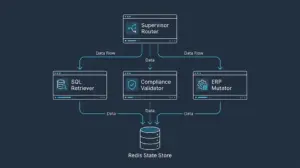
Here a central orchestrator node serves as a stateful router. It takes in the initial trigger payload, either decomposes the objective or assesses the current state object, and hands execution off to specialized worker agents further down the graph. The important detail is that workers never talk to each other directly: each one runs its own toolset, records structured output in the shared state, and passes control back to the supervisor.
The pattern fits customer operations or dynamic incident response, where the order of necessary checks depends on what turns up at runtime. Suppose the SQL Retriever worker finds that a shipping manifest is missing; the supervisor can then send the state to a Logistics Carrier API worker first and call the Compliance Validator afterward.
2. Fixed DAG Control Flow With Agents Inside the Nodes
In tightly regulated back-office work such as insurance claims adjudication or KYC (Know Your Customer) onboarding, letting even a supervisor LLM choose the next step adds more non-determinism than is acceptable. Engineers in these settings hardcode the control flow in ordinary deterministic code, using if/else conditional edges, and confine specialized agents to the nodes, where they take on policy summarization, fuzzy entity matching or extraction from unstructured data. The graph ensures Step B runs only after Step A has produced a validated Pydantic schema or a signed hash, combining the discipline of conventional software engineering with what probabilistic models can do.
3. Reflection Loops: Evaluator Paired With Optimizer
For high-stakes artifacts—complex configuration files, legal replies that customers will read, automatically generated SQL migration scripts—one generation pass is seldom enough. An evaluator-optimizer sub-graph couples a generator agent with a separate critic agent. The generator writes a draft, and the critic, armed with static analysis, deterministic linters or tight policy rubrics, tries to find what is wrong with it. When the critic rejects a draft, it writes structured feedback about the errors into the state object, then sends execution back to the generator, repeating for a capped number of retry cycles.
Building the State Management Layer
The architectural error seen most often in multi-agent systems is handing the full conversation transcript from each agent to the next. As database dumps, raw JSON responses from REST APIs and wordy chain-of-thought traces pile up in the message list, downstream agents run into “lost-in-the-middle” retrieval degradation and token bills that keep climbing.
Multi-agent workflows in production drop unstructured message passing in favor of a mutable, strictly typed State Schema kept in a fast external store like PostgreSQL or Redis.
from typing import TypedDict, List, Optional
from pydantic import BaseModel, Field

class LineItemDiscrepancy(BaseModel):
    sku: str = Field(description="Standardized product identifier")
    billed_unit_price: float
    contract_unit_price: float
    variance_amount: float

class ReconciliationWorkflowState(TypedDict):
    transaction_id: str
    vendor_id: str
    raw_invoice_s3_uri: str
    extracted_po_number: Optional[str]
    discrepancies: List[LineItemDiscrepancy]
    compliance_passed: bool
    human_approval_status: str  # "PENDING", "APPROVED", "REJECTED"
    retry_count: int
    error_trace: Optional[str]
With a state contract such as the ReconciliationWorkflowState shown above in place, every agent node reads only the keys it needs and returns nothing more than a deterministic diff:
- Ingestion Agent: starting from
raw_invoice_s3_uri, it performs optical character recognition (OCR) plus structured extraction, and fills inextracted_po_number, keeping the raw text of the 15-page PDF out of the shared state. - Audit Agent: using
vendor_idtogether withextracted_po_number, it runs a lookup against the ERP system, calculates line-item variances with a deterministic Python tool, and fills thediscrepanciesarray. - Checkpointing and Resumability: Each time a node finishes, the orchestration runtime serializes the
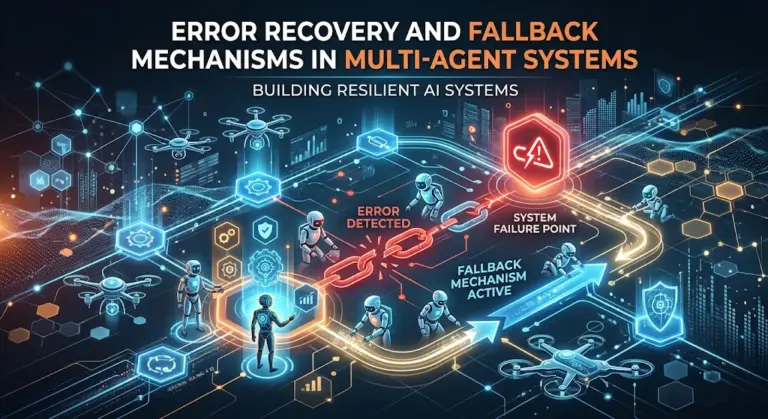
ReconciliationWorkflowStatedictionary and stores a checkpoint in PostgreSQL. Should a downstream API return a 503 outage at the fourth step, nothing forces the workflow to repeat the OCR extraction or query the ERP database again; a worker with exponential backoff just loads the most recent committed checkpoint and picks up exactly where the failure occurred.
Communication Between Agents and Schema Enforcement
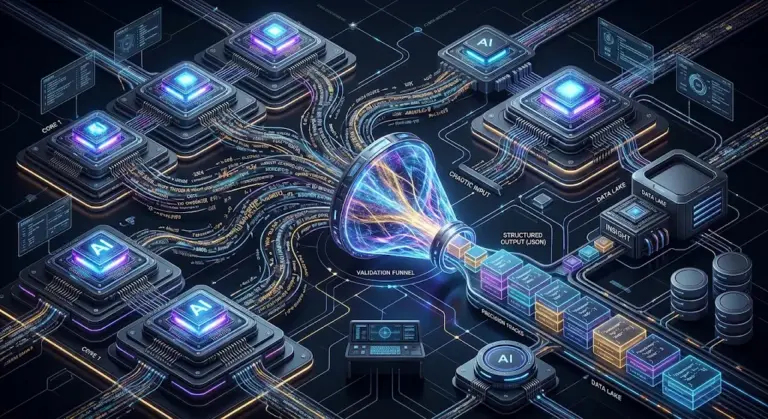
Malformed data handed from an upstream agent to a downstream one causes errors to multiply exponentially, an effect called cascading hallucination. So that a minor parsing mistake in Node 1 cannot lead Node 3 to modify the wrong customer record, engineers apply strict schema validation at every boundary through constrained decoding, also known as structured outputs.
Instead of a loose instruction asking the agent to write up its conclusions for whoever comes next, the orchestration layer attaches a strict Pydantic model or JSON Schema to the inference call itself. Current inference engines compile the schema to a context-free grammar (CFG), which blocks invalid tokens by masking their probabilities during generation and so yields 100% syntactic compliance.
Validation also has to extend past syntax into semantic verification:
- Cross-Field Validation: When an extraction agent emits
total_amount: 1500.00alongside three line items worth400.00apiece, a deterministic Pydantic@model_validatorhook raises aValueErrorstraight away, before the state gets committed. - Self-Correction Routing: When validation throws, the framework running the graph catches the error, packages the exact stack trace as a short-lived correction message, and sends the work back to the same agent with
retry_count += 1. Whenretry_countpasses a hard limit (usually 2 or 3 attempts), the node gives up and routes the workflow into a failed-message parking queue.
Guardrails: Security, RBAC and Human Approval (HITL)
Unchecked autonomy is not acceptable for enterprise operations that touch systems of record. Making a multi-agent workflow secure means separating permissions node by node and building required human approval gates into any high-consequence mutation.
Scoped Identity and Access Management (IAM)
One API key or database connection string should never be shared by every node in the orchestration graph. Give each agent role its own service account instead:
- Retrieval Agents get read-only database credentials (
SELECTpermissions only) limited to particular database views, so they have no way to drop tables by accident or see sensitive HR data. - Agents that ingest outside input, which handle untrusted inputs such as support tickets, webhooks and emails, run inside network-isolated sandboxes that have no outbound internet access and no route to internal mutation APIs.
- Mutation Agents, the ones issuing
POST,PUT, orDELETErequests to Stripe, SAP, or Salesforce, take input only from the validated internal state object—never from raw user text—and need signed execution tokens that the compliance validator node issues.
Asynchronous Human-in-the-Loop (HITL) Interrupts
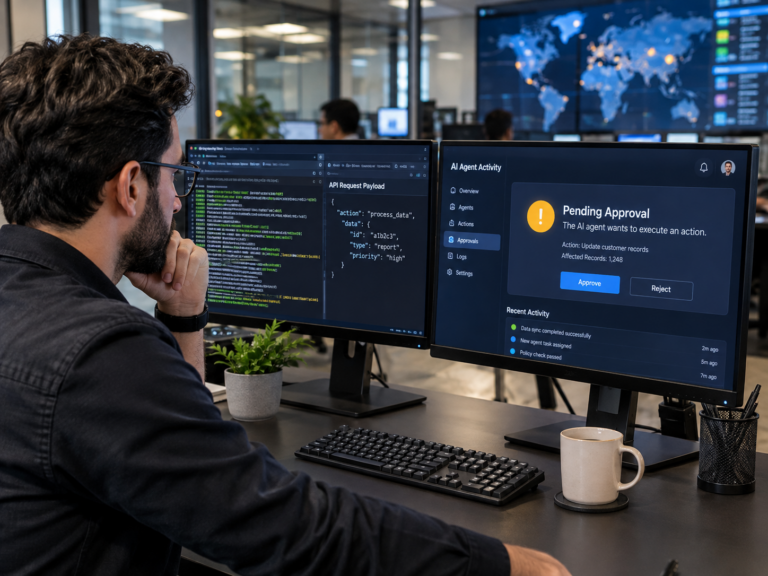
If a workflow reaches a low confidence score or a high-value transaction (say, a vendor credit above $5,000), it has to pause without keeping an expensive compute thread or HTTP connection open.
- State Serialization: Before the
ERP Mutatornode runs, the workflow reaches a pre-execution interrupt hook. The runtime persists a snapshot of the present state, settinghuman_approval_status = "PENDING". - Notification by Webhook: An emitter sends an interactive payload to an internal ticketing queue, a Microsoft Teams webhook or a Slack channel, including a summary of the transaction, the computed discrepancies and links back to the original files.
- Releasing the Worker: The pod running the job exits cleanly and gives back its CPU and memory.
- State Hydration and Resume: When an operations manager presses “Approve” in the internal portal, perhaps hours or days afterward, an inbound webhook calls the orchestrator API with the
transaction_idplus the manager’s digital signature. The runtime rehydrates the state from the database, setshuman_approval_status = "APPROVED", and calls theERP Mutatornode to complete the transaction.
Tracing, Observability and Spend Control
Once five agents are running parallel tool calls and retry loops, working out why a multi-agent run failed from ordinary application logs is close to hopeless. Production deployments use OpenTelemetry (OTel) instrumentation to record hierarchical distributed traces that span the full workflow lifecycle.
Propagating Trace Context
Each workflow execution gets its own root trace_id. Tool calls, vector retrievals, validation retries and agent invocations each become a child span that carries structured metadata attributes:
agent.role: Names the particular node (for example,compliance_validator_v2).llm.model_name: Records which model weights handled the span.llm.token_count.promptandllm.token_count.completion: Allow fine-grained cost attribution by workflow step and by business department.tool.execution_latency_ms: Distinguishes LLM inference latency from slowdowns in internal ERP or database APIs.
Guarding Against Runaway Loops and Token Spikes
So that a conditional routing bug cannot drain API budgets over a weekend, engineering teams put hard circuit breakers into the orchestration layer:
- Maximum Graph Steps (
recursion_limit): Set a fixed cap on how many node transitions a single workflow instance may make (15 steps at most, for instance). When a supervisor and a worker become trapped in a clarification loop, the runtime forcibly ends execution at step 15 and raises a PagerDuty alert. - Token Budgets per Workflow: Keep a running total of token spend in the shared state object. Once one transaction goes past $0.50 of accumulated inference cost, the orchestrator stops automatic processing and hands the payload over for manual review.
- Heterogeneous Model Routing: Keep frontier reasoning models for the supervisor’s planning node or complex policy synthesis only. Send routine nodes—classification, entity extraction, schema formatting—to fine-tuned small language models (SLMs) served on dedicated TensorRT-LLM or vLLM instances, which can lower operational cost per workflow by as much as 75% and halve end-to-end latency.
Frequently Asked Questions
1. When does a deterministic DAG make more sense for an enterprise than a dynamic supervisor multi-agent architecture?
Pick a deterministic Directed Acyclic Graph (DAG) any time the standard operating procedure follows a fixed series of business or regulatory steps, as in employee onboarding, automated compliance auditing or three-way invoice matching. Save dynamic supervisor architectures for unstructured problem areas such as open-ended market research or diagnosing tier-three technical support issues, where nobody can predict the order of tool calls until intermediate data comes back.
2. How can infinite loops between communicating agents be prevented in production?
Three mechanisms handle it: replacing open-ended peer-to-peer chat with structured supervisor routing, keeping a strict retry_count integer in the shared state object for each validation loop, and setting a hard recursion_limit (a maximum step count) at the graph runtime that ends execution and notifies on-call engineers when it is reached.
3. Will dividing a workflow among several agents make it slower overall?
Run strictly in sequence on large frontier models, a multi-agent workflow can add latency because of the extra network round-trips. In practice, though, multi-agent systems frequently beat monolithic prompts on speed, since every worker handles a far smaller, trimmed context window, relies on quicker small language models (SLMs) for specialized extraction, and can run independent retrieval branches at the same time by fanning work out in parallel, asynchronously.
4. What is the right handling for sensitive PII when agents share a state store?
Personally identifiable information (PII) that is sensitive—health records, credit card details, Social Security numbers—belongs behind tokenization at the ingestion edge, which happens before any workflow state exists. Agents handle nothing but opaque reference tokens (for example, CUST_TOKEN_8921), and only the final mutation tool, scoped by permission, swaps the tokens back for real values within a secure enclave, right before it calls the downstream system of record.
5. How should a multi-agent workflow be evaluated and tested ahead of deployment?
Testing calls for a continuous integration (CI) strategy with two tiers. Start with unit tests for each agent node that rely on deterministic schema validators and frozen mock states to confirm tool-calling accuracy. Then evaluate full trajectories end to end on a golden dataset built from past enterprise transactions, checking that the graph follows the best routing path and makes exactly the expected database mutations while staying within token and latency thresholds.
References and Technical Sources
- OpenTelemetry semantic conventions for GenAI systems (specification): Standard telemetry attributes for tracing calls to LLMs, token metrics and the spans produced by agent tools. (
[https://opentelemetry.io/docs/specs/semconv/gen-ai/](https://opentelemetry.io/docs/specs/semconv/gen-ai/)) - OWASP Top 10 for LLM Applications & GenAI: Enterprise-oriented security guidance covering Excessive Agency (LLM06), indirect prompt manipulation (LLM01) and insecure plugin or tool design. (
[https://genai.owasp.org/](https://genai.owasp.org/)) - NIST AI Risk Management Framework (AI RMF 1.0): US federal guidance on how to govern, map, measure and manage risk when enterprises deploy autonomous or semi-autonomous AI. (
[https://www.nist.gov/itl/ai-risk-management-framework](https://www.nist.gov/itl/ai-risk-management-framework)) - LangGraph documentation on stateful multi-actor applications: Engineering patterns for reducers over the state schema, checkpointers for persistence, and graph interrupts that hand control to a human reviewer. (
[https://langchain-ai.github.io/langgraph/](https://langchain-ai.github.io/langgraph/)) - AutoGen (Microsoft Research), on multi-agent conversation as a basis for next-generation LLM applications: Foundational work on coordinating human proxies, code executors and specialized agents that talk to each other inside complex workflows. (
[https://arxiv.org/abs/2308.08155](https://arxiv.org/abs/2308.08155))