Designing a Microservices Architecture for Modular AI Application Stacks
The first Generative AI application an enterprise engineering team ships is nearly always a monolith. Typically it is one large Python service built on FastAPI or Flask, a single LangChain or LlamaIndex orchestration script, and synchronous HTTP calls made directly to a cloud vector database and to an LLM provider such as OpenAI or Anthropic.
As a proof-of-concept, nothing is wrong with that design. Debugging is easy, deployment is quick and version control is simple. Once the prototype moves into production and has to serve thousands of enterprise users at the same time, though, the monolith eventually gives way.
Enterprise-grade AI calls for a move away from monolithic scripts toward a distributed Microservices Architecture. When ingestion of data, orchestration, semantic retrieval and LLM inference are split into separate services that scale on their own, organizations get modular AI stacks that tolerate faults, avoid dependence on any one vendor and keep costs well under control. This engineering case study describes the architectural patterns needed to separate AI workloads cleanly, along with the particular scaling failures that this approach heads off.
Architect’s Notes: Why the AI Monolith Falls Short
The argument for microservices becomes clear once you look at the resource conflicts built into a monolithic AI application. The compute demands of AI workflows swing enormously from one step to the next.
- I/O bound vs. CPU bound: Taking in a request from a user and pushing SSE (Server-Sent Events) responses out to the client is overwhelmingly I/O bound. Running a local Cross-Encoder to re-rank retrieved documents, or producing dense vector embeddings, is the opposite: heavily CPU/GPU bound.
- The Python constraint: Most AI libraries are Python libraries. Inside a monolith, Python’s Global Interpreter Lock (GIL) rules out genuine thread-level concurrency. When a heavy data-chunking job holds the main thread, every user waiting on an LLM text stream sees an abrupt jump in latency or loses the connection.
Splitting the monolith into microservices lets you match each task with the programming language and hardware that suit it. Go or Rust services with high concurrency can handle I/O-bound routing on inexpensive CPUs, while demanding embedding work stays in Python microservices assigned to dedicated GPU clusters.
Laying Out the Modular AI Microservices Stack
An AI stack ready for production should be divided into no fewer than five separate, stateless microservices that talk to each other over gRPC or through asynchronous message brokers.
1. Edge Layer: API Gateway and Streaming Router
This is the entry point. Implemented in a language built for concurrency (Go/Rust/Node.js), it does only one job: it handles incoming WebSocket or HTTP connections, authenticates users, applies rate limits and streams the finished text chunks back to the client. There is no AI logic in it at all. When traffic surges, Kubernetes can scale this small service out horizontally within seconds, with no wait for large models to load into memory.
2. Decision Layer: The Orchestration Engine
Usually written in Python or TypeScript, the orchestrator plays the role of the “Agent.” It receives each user prompt from the Gateway and works out how to execute it: whether to search the vector database, call an external API tool (to look up live weather or a stock price, say) or pass the prompt straight to the LLM. It also holds conversation state and coordinates the microservices further down the chain.
3. Memory Layer: Embedding and Retrieval Service
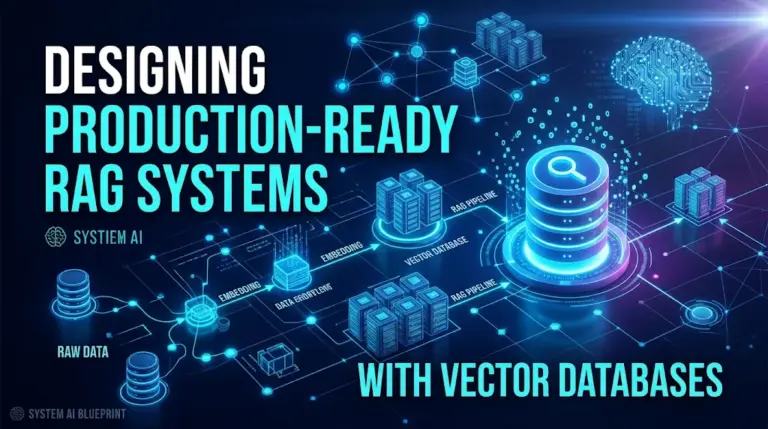
This service sits in front of your Vector Database (Qdrant, Milvus or Pinecone, for example) and hides it from the rest of the system. It accepts raw text from the Orchestrator, turns it into numeric vectors with a locally hosted embedding model such as BGE-M3, and runs the hybrid search against the database. Because it is isolated, you can later replace the vector database vendor without changing anything else in the stack.
4. Action Layer: Workers That Execute Tools
Whenever the AI agent has to run code, query a production database with SQL or reach internal company APIs, that work belongs in isolated sandboxes. Tool Execution workers subscribe to a message queue (Apache Kafka or RabbitMQ, for example). Whenever the Orchestrator wants SQL executed, it posts a message to the queue; a worker takes it, runs the possibly risky code inside a locked-down, isolated Docker container and sends back the result. That way a hallucinated LLM instruction cannot bring down the core application.
5. Voice Layer: A Proxy for LLM Inference
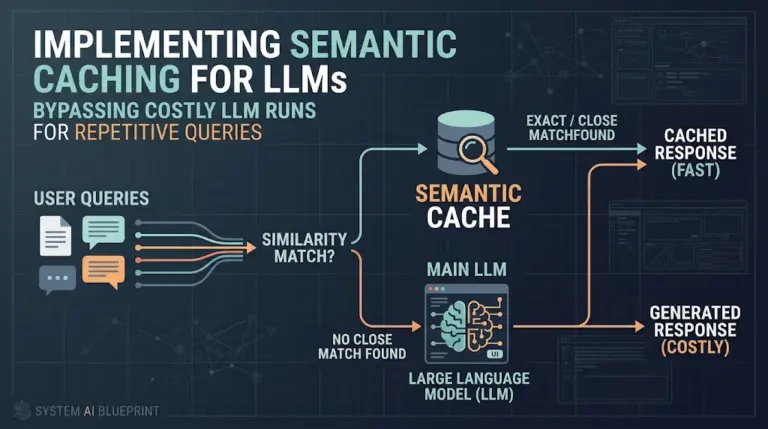
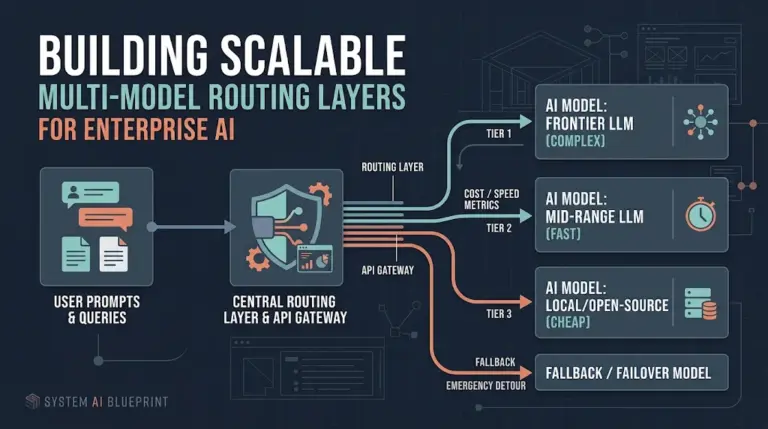
Instead of letting each microservice talk to OpenAI or Anthropic on its own, every LLM API call goes through an internal Inference Proxy. The proxy holds the vendor API keys, retries requests that hit HTTP 429 (Rate Limit) errors and performs semantic caching. Should OpenAI become unavailable, this one microservice switches over immediately to an Anthropic or Google model, and nothing else in the application notices that the vendor has changed.
Failure Scenarios from Practice (and How Microservices Solved Them)
Moving to microservices brings network latency and added architectural complexity with it. Below are the particular failures our engineering team ran into during the migration, together with the design patterns that resolved each one.
Failure Scenario 1: A Cascade of Synchronous Timeouts
The Incident: In the first version of our microservices stack, the Orchestrator reached the Retrieval Service through synchronous REST HTTP calls. A huge surge of internal traffic caused the Vector Database to slow down briefly, and the Retrieval Service started answering in 10 seconds rather than 50 milliseconds. Since the calls were synchronous, Orchestrator threads sat blocked while they waited. Inside two minutes the whole Orchestrator service had used up its available threads and went down, which took the entire AI application offline with it.
The Engineering Fix: Synchronous REST calls were replaced with an Asynchronous Message-Driven Architecture. Now the Orchestrator emits a “Search Requested” event onto a topic in Apache Kafka and frees its processing thread straight away. The Retrieval Service consumes that event, queries the database at whatever pace it can manage and publishes a “Search Completed” event, which the Orchestrator collects asynchronously. When the database slows, messages just accumulate in Kafka and the upstream services keep running.
Failure Scenario 2: Running Out of GPU Memory During Deploys
The Incident: The original monolith packaged the BGE-Large embedding model and the 8-Billion parameter Llama-3 model (used for summarization) into one Python deployment. Each new Kubernetes pod started to absorb web traffic tried to load both large models into GPU memory, and the result was often an unrecoverable CUDA Out-Of-Memory (OOM) failure.
The Engineering Fix: The models were separated completely using the Sidecar Pattern. Web application logic went into one small container that needs very little RAM, and the LLM and embedding models became independent microservices running on specialized GPU node pools. From then on, the web containers could scale out 100x on their own without pointlessly copying the heavy machine-learning models each time.
Failure Scenario 3: Prompt Versions That Did Not Match
The Incident: A change to the prompt engineering logic in the Orchestrator asked the LLM for output in a particular JSON schema. The LLM Inference Proxy, however, was still serving from an older semantic cache whose entries were plain strings. The Orchestrator tried to parse those cached strings as JSON and threw thousands of parsing exceptions.
The Engineering Fix: Strict gRPC Protobuf Contracts were introduced between services. Microservices no longer exchange loosely shaped JSON objects; they all communicate through strictly typed Protocol Buffers. If a StructuredJSON object is what the Orchestrator expects, the contract defined in gRPC makes it impossible for the Inference Proxy to hand back a raw string. Backward compatibility was enforced this way, and schema mismatches surfaced during the CI/CD build rather than in live production.
A Diagnostic Matrix for Microservices
Running a distributed AI architecture demands very targeted observability. The matrix below lists the telemetry our SRE team uses to diagnose AI workflows that span several services:
| Telemetry Signal | Likely Root Cause | Architectural Response |
| Orchestrator CPU usage jumps while network I/O stays low | The Orchestrator is probably tied up concatenating huge context-window strings on its own instead of handing that work off. | Hand token counting and context truncation over to a separate high-performance worker node written in Rust. |
| Backlog growing on the Kafka “Tool Execution” topic | AI agents are asking for slow external tools (web scraping or very large SQL joins, for example) faster than workers can run them. | Auto-scale the Tool Execution worker pods horizontally. Add a timeout so the LLM learns that the tool failed and can tell the user politely. |
| Elevated gRPC latency between the Orchestrator and the Inference Proxy | Either the network between Kubernetes namespaces is congested, or the Proxy is stuck waiting on LLM cloud providers. | Look at external API latency first. If those APIs are healthy, confirm that gRPC connections share HTTP/2 through multiplexing and that connection pooling is switched on. |
| Vector DB connection pool used up | During ingestion, the Retrieval microservice opens a fresh database connection for each incoming text chunk. | Add connection pooling (PgBouncer in front of pgvector, for example) and require batching, writing embeddings to the database 100 at a time instead of one after another. |
Taking the monolithic AI application apart gives system architects fine-grained control over compute spending, fault tolerance and the speed at which developers can ship. Operating Kubernetes, gRPC and Kafka carries a heavy operational load at first, yet a microservices architecture remains the one proven way to run Generative AI applications that can withstand enterprise-scale traffic.
Frequently Asked Questions
1. How does a monolithic AI app differ from a microservices AI app?
In a monolithic AI application, every process (prompt engineering, web routing, external API calls and vector database queries) lives in one codebase and runs on one server instance. A microservices architecture breaks those functions into small, independent programs that talk over a network, so you can scale just the parts of the system under heavy load instead of copying the whole application.
2. Why write the API Gateway in Go or Rust rather than Python?
AI chatbots stream text to the user one word at a time using Server-Sent Events (SSE), so each connection stays open for a long while. Because of its synchronous nature and the Global Interpreter Lock (GIL), Python is very inefficient at keeping thousands of connections open at once. Go and Rust were built for large-scale I/O concurrency, which makes them a natural fit for the Gateway layer.
3. Does an AI application need Kafka or RabbitMQ?
Not for simple internal tools. For dependable enterprise AI agents that carry out complex, multi-step workflows, such as scraping a website, drafting a report and emailing it, you need a message broker such as RabbitMQ or Kafka. If a worker fails partway through a task, the message survives and another worker can take it over and continue the autonomous workflow.
4. In what way does a microservices architecture avoid AI vendor lock-in?
Through an internal LLM Inference Proxy microservice. When your core orchestration engine speaks only to that internal Proxy in a standard format, engineers can switch the underlying AI provider (moving from OpenAI to Google or to a local Llama model) entirely inside the Proxy service, and the rest of the microservices stack needs no code changes at all.