Incremental ETL Pipelines That Keep Vector Indexes Current in Real Time
Anyone whose application combines Retrieval-Augmented Generation (RAG) with Large Language Models (LLMs) soon runs into the main bottleneck: keeping the knowledge base current. Loading historical data into a vector database is simple. Keeping that database in step with live production data that never stops changing, without grinding the system to a halt, is a completely different problem.
Whenever someone edits a document, rewrites a product description, or removes an outdated record, the RAG application has to pick up that change straight away. If you depend on nightly batch jobs, your AI will hand out stale and wrong answers for hours at a time.
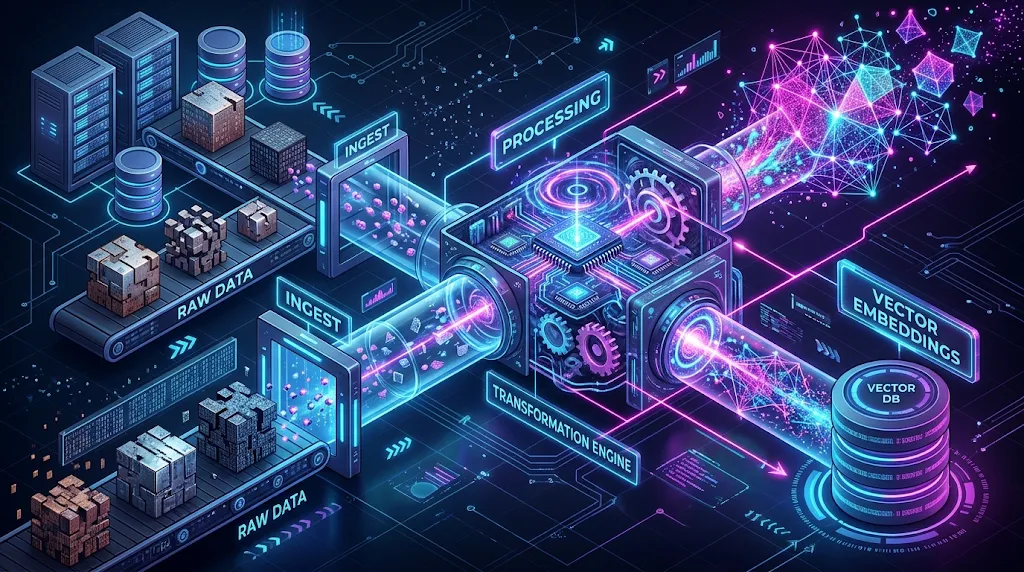
What fixes this latency gap is an incremental ETL (Extract, Transform, Load) pipeline, built specifically for real-time vector indexing. Below we walk through how to design, build, and scale a system that keeps embeddings current down to the millisecond.
Why Classic Batch ETL Falls Short for Vector Databases
Before getting to the solution, it is worth seeing why the older approach to moving data stops working in modern AI architectures.
Conventional ETL pipelines run on a timetable, typically hourly or nightly. They pull data in bulk from a primary database, apply heavy transformations, and overwrite the target storage. That is perfectly adequate for ordinary data warehousing. For vector databases it causes serious trouble, for three reasons:
- Huge Compute Costs: Producing vector embeddings takes a lot of computation. Recomputing embeddings for a whole dataset when only 5% of its records changed wastes API credits and GPU hours.
- High Latency: A RAG system that answers customer support questions from an out-of-date policy document can create real compliance problems. With batch processing, your AI is by design always lagging behind reality.
- Missed Deletes: Batch jobs frequently have trouble spotting rows that were removed. If a sensitive file is removed in your app while its embedding stays searchable until the following batch cycle, that is a serious security flaw.
What Does Incremental ETL Mean?
Incremental ETL, usually built on an event-driven architecture, handles data one row or document at a time, at the very instant a change happens. It does not copy the entire database; it watches for particular operations, namely Inserts, Updates, and Deletes, which are commonly grouped under the term CRUD operations.
As soon as it sees a change, the pipeline pulls out just the affected record, transforms it by chunking it and producing an embedding, and then runs an ‘upsert’ or ‘delete’ against the vector database.
Key Building Blocks of a Real-Time Vector Pipeline
A dependable incremental ETL pipeline rests on four main structural pieces.
1. Change Data Capture (CDC)
CDC drives the entire incremental pipeline. Rather than sending expensive SQL queries at your primary database to work out what changed, CDC tools read its transaction log, for example the WAL in PostgreSQL or the binlog in MySQL. Every event is captured in real time, and the primary database’s performance is left untouched.
2. The Message Broker
An event captured by CDC needs somewhere to land. The message broker serves as the central nervous system, keeping those events in a queue or stream until downstream services can handle them. If the embedding service goes offline for a while, nothing is lost.
3. Stream Processing & Embedding Generation
Here is where the ‘Transformation’ step takes place. The pipeline reads raw text off the message broker, tidies it up, cuts it into manageable chunks, and passes it to an embedding model such as text-embedding-3-small from OpenAI or a HuggingFace model running locally.
4. Upserting into the Vector Database
Last of all, the resulting vector is written to a vector database together with its metadata and the original ID. A new record gets inserted. An updated record has its old vector overwritten. And for a “delete” coming from CDC, the index loses that vector entirely.
Building the Pipeline Step by Step
Here is a hands-on implementation of this architecture built with current data engineering tools.
Step 1: Configuring CDC with Debezium
Among open-source Change Data Capture tools, Debezium is the industry standard. It attaches directly to the source database, PostgreSQL for instance.
The moment a row in the documents table changes, Debezium reads the Write-Ahead Log (WAL) and builds a JSON event describing that change, recording both the row’s ‘before’ and ‘after’ states. Kafka then receives the event on a topic.
Step 2: Streaming Events Through Apache Kafka
Kafka works as a shock absorber. Suppose someone bulk-updates 100,000 records in the database; trying to process all of them at once will probably push your embedding API past its rate limit.
Kafka keeps those 100,000 CDC events safe in a partitioned topic. A downstream consumer can then work through them at a measured pace, so the embedding provider is never flooded and no data goes missing.
Step 3: Chunking and Transforming Text
Vector models enforce strict token limits, known as context windows. Squeezing a 50-page PDF into one vector and hoping for good retrieval simply does not work.
The stream processor, whether a custom Python microservice built on Faust or a tool such as Apache Flink, pulls text off Kafka and runs it through a chunking strategy.
- Recursive Character Chunking: Splits text along paragraph and sentence boundaries so context is preserved.
- Semantic Chunking: Relies on NLP so that every chunk captures a complete thought.
Key detail: For incremental chunking, every chunk needs a deterministic ID, such as docID_chunkIndex. Without it, you cannot reliably update or overwrite particular chunks later on without creating duplicates in the vector database.
Step 4: Producing Embeddings
After chunking, the payload goes to the embedding model. Network calls are slow, so this stage should be heavily asynchronous. Rely on Python’s asyncio or dependable background workers such as Celery to handle many chunks in parallel.
Pro Tip: Add retry logic with exponential backoff at this point. When the OpenAI API answers with a 429 Too Many Requests error, the pipeline should pause and try again instead of discarding the data.
Step 5: Upserting into the Vector Database
The last stage syncs everything with your vector database, whether that is Pinecone, Qdrant, Milvus, or Weaviate.
A payload will look roughly like this:
- ID:
123_chunk_1 - Vector:
[0.015, -0.022, 0.089, ...] - Metadata:
{"author": "John Doe", "category": "finance", "timestamp": 1709230000}
When the source CDC event was a DELETE, the stream processor has to skip chunking and embedding altogether. It should instead send the vector database a delete command right away, covering every vector tied to that parent document ID.
Best Practices for Running in Production
Getting the pipeline built is only half the job. Keeping it stable in production takes defensive engineering.
1. Idempotency Is Essential Distributed systems occasionally deliver the same message twice. The pipeline therefore has to be idempotent: handling an identical update a second time must not create duplicate vectors. Rely on UPSERT (Update/Insert) commands keyed on primary keys instead of blind INSERTs.
2. Managing Metadata On their own, vectors are of limited use without solid metadata. Every vector should carry timestamps, document categories, and access control lists (ACLs). That lets the RAG application run hybrid searches, for example “match this semantic meaning, but only among documents created after 2023”.
3. Failed-Message Queues A chunk that cannot be embedded because of an unexpected character encoding problem should not halt the entire pipeline. Send such events to a separate failed-message queue. The pipeline keeps working through healthy data, and the engineering team can examine and replay the failed events later.
Final Thoughts
Moving vector databases from batch ETL to incremental ETL is a significant architectural change. It means leaving simple Cron jobs behind in favor of sturdy, event-driven streaming systems. The return on that effort is large, though. With CDC, Kafka, and well-designed chunking microservices in place, your generative AI applications always work from the most current and accurate data, giving end users a smooth and genuinely intelligent experience.
Frequently Asked Questions
Q1: How does batch ETL differ from incremental ETL for vector databases?
Batch ETL handles big volumes of data on a fixed schedule and overwrites the target storage, which leads to high latency and spends compute on data that has not changed. Incremental ETL handles only changed data (inserts, updates, deletes) in real time, so vector indexes stay continuously current at a low compute cost.
Q2: Which vector databases can handle real-time upserts?
Nearly every modern vector database is built for real-time upserts and point lookups. Well-known choices include Pinecone, Qdrant, Milvus, Weaviate, and the PostgreSQL extension pgvector.
Q3: How should document deletions be handled in a vector database?
With a Change Data Capture (CDC) tool such as Debezium, the pipeline can spot a delete event in the source database. It should then take the document’s unique ID and send the vector database a targeted API request that removes every vector chunk linked to that ID.
Q4: Does an incremental ETL pipeline require Apache Kafka?
No. Kafka dominates high-throughput streaming in industry, but lighter options may suit your scale better. RabbitMQ, Redis Streams, or Amazon Kinesis can likewise serve as dependable message brokers that buffer CDC events ahead of embedding generation.
Q5: How can a real-time pipeline stay within embedding API rate limits?
Put a message queue such as Kafka in place to regulate the data flow, and pair it with asynchronous processing and exponential backoff retries in your code. If your embedding provider allows it, you can also group several chunks into one API request to get the most throughput.
Sources & References
- Debezium Documentation: How Change Data Capture (CDC) pipelines are structured, with common design patterns. (debezium.io)
- Pinecone Vector Database Guides: Recommended approaches to vector upserts, metadata filtering, and keeping indexes in sync in real time. (pinecone.io/learn/)
- Apache Kafka Streaming Concepts: Guidance on event-driven architecture, message brokering, and reliable data streams. (kafka.apache.org)
- OpenAI API Documentation: Notes on text embedding models, handling rate limits, and strategies for managing tokens. (OpenAI platform docs)