Building Resilient API Gateways for Enterprise AI Traffic
After ten years of building microservices, it is easy to believe you already understand API gateway configuration. You put a reverse proxy in front, cap traffic at 1,000 Requests Per Minute (RPM), add an OAuth2 validation policy, and consider the job finished.
When my team was asked to roll out a Generative AI layer across the whole enterprise, we expected that familiar playbook to carry over. We aimed our existing API gateway at our main Large Language Model (LLM) providers, sent our internal applications through it, and shipped to production.
Inside 48 hours the whole system had fallen over. It became clear very fast that LLM APIs behave nothing like conventional RESTful services. They are extremely unstable, depend on asynchronous streaming connections that stay open for a long time, and bill by payload size, which is hard to predict, instead of by plain request counts. A conventional gateway is a quick and fairly simple pipe, whereas AI workloads call for orchestration that is intelligent and stateful.
This technical write-up walks through how our architecture evolved, the failure cases that took down our first design, and the fault-tolerant mechanisms we built so the gateway could securely and dependably serve upward of 10,000 AI requests every second.
Architect’s Notes: How AI Traffic Overwhelms Conventional Gateways
Before we get to the solution, it is worth recording precisely why conventional gateways break down under AI workloads. Knowing these limits is what a resilient architecture is built on.
The Volume-Based Rate Limiting Problem (RPM vs. TPM)
Ordinary APIs limit callers by Requests Per Minute (RPM). AI APIs set quotas in Tokens Per Minute (TPM) instead. That creates a big distributed systems problem: when a request arrives at the gateway, nobody knows how long the eventual output token stream will be. One user asking for a 4,000-token summary can use up a whole department’s quota in an instant, slipping straight past a basic RPM limiter.
Asynchronous SSE Streams
A typical REST API sends back a JSON payload within a few hundred milliseconds. LLMs rely on Server-Sent Events (SSE) to push tokens to the client one at a time, and that can last as long as 30 seconds. Gateways designed around blocking I/O run through their connection pools quickly when they must keep thousands of these long-running streams open at the same moment.
Probabilistic Volatility
Cloud LLM providers regularly suffer from degraded performance, sudden latency jumps, and silent failures. Tie your internal applications to one vendor’s API schema and your tools stop working the moment that vendor has an outage.
The Design: Splitting the Control Plane from the Data Plane
To get past these scaling problems, we dropped the monolithic gateway model and moved to a decoupled architecture with two separate planes.
- The Control Plane: This is the gateway’s administrative brain, and it never touches live traffic. Its job is managing configuration: routing rules that change at runtime, API keys per tenant, chains of fallbacks, and each department’s token budget. It keeps pushing that state into a distributed, extremely fast in-memory cache.
- The Data Plane: Here sits the stateless, massively concurrent engine that does the real work of handling HTTP traffic, transforming payloads, and streaming tokens back to users. Because it holds no state, we can scale it out horizontally across Kubernetes clusters during traffic peaks without having to worry about race conditions.
Failures We Hit in Production (and How We Resolved Them)
On a whiteboard, architecture diagrams are always flawless. Below is what really happened once production load arrived, along with the fault-tolerant mechanisms we built as a result.
Failure Scenario 1: The Cascading 429 Failover
What happened: In the middle of a large internal rollout, our main LLM provider began answering with HTTP 429 (Too Many Requests). Lacking adequate retry logic in our frontend applications, we saw thousands of connections dropped and UIs froze.
The Engineering Fix: We built a Circuit Breaker Pattern with smart failover right into the gateway layer. The circuit breaker moves between three states:
- Closed: Traffic goes to the primary LLM vendor as usual.
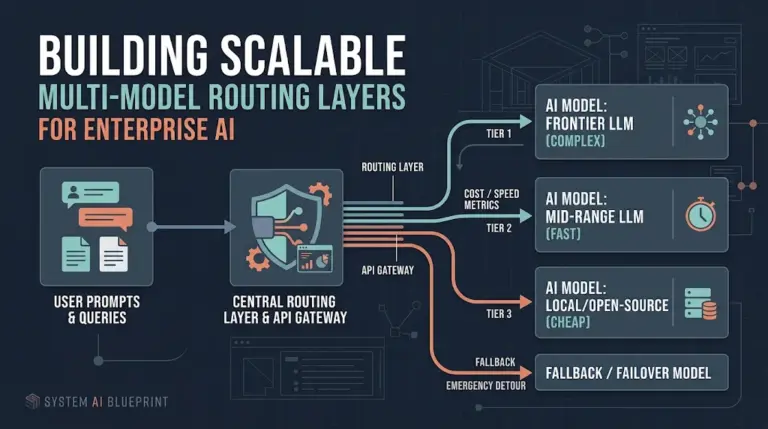
- Open: Once the gateway sees a failure threshold, for example five 5xx or 429 errors inside a 60-second window, the circuit “trips”. The gateway catches the error rather than dropping the request and quietly sends the prompt to a secondary provider instead, such as switching from OpenAI to Anthropic.
- Half-Open: When a 30-second cooldown has passed, the gateway lets a handful of test requests reach the primary provider. Success closes the circuit; failure keeps it open.
For this to work, the gateway has to rewrite request structure on the fly. It catches the HTTP 429, converts one provider’s particular JSON array into the shape the backup provider expects, and sends the request again, all within 20 milliseconds, so the client application never notices the failover.
Failure Scenario 2: “Thundering Herd” Token Exhaustion
What happened: A runaway Python script from a data analyst fired off 500 simultaneous requests asking a frontier model to work through huge text files. That hit our company-wide TPM limit and locked every team out for 15 minutes.
The Engineering Fix: Basic gateway throttling was no longer enough, so we built distributed rate limiting that works on several levels.
- Predictive Quotas: The gateway now inspects each payload and runs a quick, lightweight tokenizer to count input tokens before routing the request anywhere.
- Tenant Isolation: Limits now apply per consumer and per route. When the Data Science department goes over its own TPM budget, only its API keys receive a 429 from the gateway. This is the bulkhead pattern, and it keeps traffic from the Customer Service department entirely unaffected.
Failure Scenario 3: Data Leakage Through Prompt Manipulation
What happened: Security audits showed that staff were unintentionally copying sensitive PII (Personally Identifiable Information) and proprietary code snippets into the chat interfaces of outside LLM vendors.
The Engineering Fix: We pushed security scanning out to the edge by embedding a local Named Entity Recognition (NER) model inside the gateway’s data plane. The gateway parses every payload before it reaches any third-party server. When it finds a Social Security Number or an internal server hostname, it redacts that value automatically and swaps in a generic token. Placing this guardrail centrally in the gateway keeps enterprise data privacy compliance intact no matter which internal tool sent the request.
The Diagnostic Matrix
Running an enterprise AI gateway means alerting on anomalies instead of fixed thresholds. Our SRE (Site Reliability Engineering) team relies on the internal telemetry matrix below to debug gateway problems in production:
| Telemetry Alert | Root Cause Analysis | Recommended Action |
| P99 Latency (TTFT) Jumps | The downstream LLM is getting worse without failing outright; no 500-level errors have appeared yet. | Lower the gateway’s Read Timeout threshold so the circuit breaker trips sooner and moves traffic to a quicker, healthier backup model. |
| Elevated 429 Rate on the Primary LLM | Either the enterprise token budget with the vendor is used up, or the vendor is throttling traffic hard. | Confirm that retries use exponential backoff with jitter. Look through the Data Plane logs to make sure fallback routing to the secondary vendor fires as expected. |
| SSE Connections Dropping | Long-running token streams are pushing gateway worker nodes out of memory (OOM) or into TCP connection limits. | Scale out the Data Plane pods automatically. Check that the load balancer keeps persistent HTTP/2 connections instead of forcing repeated TLS handshakes. |
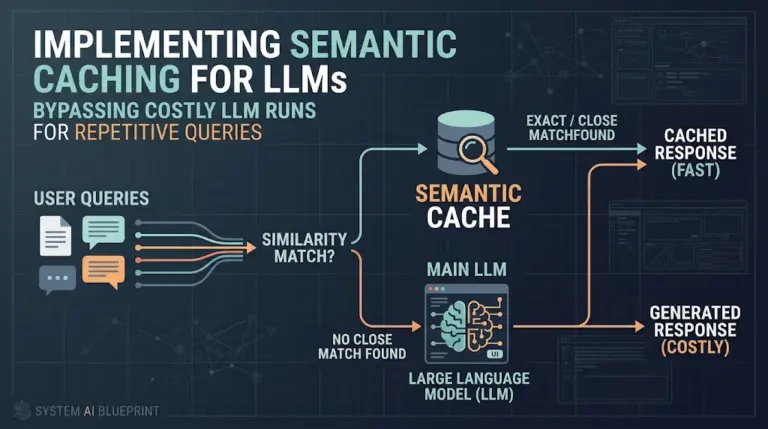
| Cache Hit Ratio Falls Under 10% | Prompts reaching the Semantic Caching layer are very unique and have little similarity to one another. | Revisit the similarity threshold configuration. For low-risk informational queries, reduce the threshold dynamically to raise the hit rate and cut downstream API spending. |
FAQs
1. Why write a custom data plane rather than adopt an open-source Python gateway?
Open-source gateways written in Python, LiteLLM among them, are great for prototypes and support a huge range of providers, yet they can have trouble keeping up with high concurrency at full enterprise scale. When thousands of asynchronous SSE token streams are in flight, Python’s Global Interpreter Lock (GIL) turns into a serious bottleneck. Where latency matters above all, the data plane is best written in a highly concurrent language such as Go or Rust, which frequently adds under 20 microseconds of overhead to each request.
2. Doesn’t rewriting payloads for failover slow things down?
It does: deep payload inspection and schema conversion consume CPU cycles. Still, the trade-off is clearly worthwhile. Spending 10 to 15 milliseconds of processing in the gateway is trivial next to the thousands of milliseconds an LLM needs to produce its answer. The resilience that comes from switching vendors instantly is worth far more than that small latency cost.
3. How is observability and distributed tracing handled across several AI models?
On its way to the LLM, a request passing through an AI gateway crosses several microservices. We require structured logging with correlation IDs, and the gateway attaches an OpenTelemetry trace ID to each request it receives. With that in place we can follow the exact Time To First Token (TTFT), per-tenant token usage, and end-to-end latency from one observability dashboard, which gives us a single view of both cost and performance.