Managing Schema Evolution and Metadata Governance in Enterprise Data Lakes
An enterprise data lake is frequently presented as the definitive answer to data silos. Organizations load huge volumes of structured, semi-structured and unstructured data into inexpensive object storage such as Google Cloud Storage, Amazon S3 or Azure ADLS. The aim is to give business analysts, data scientists and machine learning models open access to information from across the whole company.
Many teams soon discover, though, that storing the data is only about 10% of the work. The hard part begins once the data starts to change.
Without firm governance, a “data lake” meant to be highly efficient can quickly turn into an unusable “data swamp.” Two causes are usually behind that decline: schema drift, where incoming data changes without notice and breaks downstream pipelines, and metadata blindness, where nobody knows what the lake holds, who owns it, where it originated or whether it meets compliance requirements.
Handling schema evolution and metadata governance is more than a technical refinement; it underpins any data-driven enterprise. The sections below explain how to design and govern these systems well.
1. The Disorder Caused by Schema Drift in Data Lakes
A traditional relational database enforces its schema (the layout of tables and columns and their data types) at write time. When a system attempts to put a string into an integer column, or to add a field that is not defined, the database refuses the operation.
Data lakes are deliberately built around a model where the schema applies on read (or on query). Developers can load Parquet, CSV or JSON files without dealing with database constraints in advance. That flexibility speeds up ingestion, but it leaves downstream consumption very fragile, and this is the point at which schema drift appears.
What Is Schema Drift?
Schema drift occurs when source systems, such as a microservice, an external API or the telemetry feed of a mobile app, alter their data structures without telling the data engineering team. Typical cases include:
- A string field renamed from
user_idtocustomer_id. - A change of data type, for example a numeric ID turning into an alphanumeric hash.
- A column that a downstream BI dashboard depends on suddenly being removed.
- New nested JSON fields that older parsing jobs are not prepared for.
The result is that Spark jobs fail, database writes are rejected, and dashboards either stop working or, worse, show incorrect figures to business stakeholders.
2. Schema Evolution and Compatibility Patterns Explained
For data to change naturally over time without disrupting existing jobs, data platforms need schema evolution: the capacity of a database or data engine to adjust smoothly as the structure of a dataset changes.
What Modern Table Formats Contribute
Legacy formats such as CSV offer no meaningful schema management. Current file and table formats, including Parquet, Apache Avro, Apache Iceberg and Delta Lake, treat schema evolution as a built-in, first-class capability.
Apache Iceberg, for instance, allows schema evolution “in place.” Traditional systems may require the whole historical dataset to be rewritten whenever a column changes, but Iceberg follows schema versions over time using metadata snapshots. Renaming a column is handled through a metadata mapping, and the physical files underneath are left untouched, so read and write queries keep working.
Selecting an Evolution Policy
Safe schema evolution depends on clear compatibility rules. Schema-management tools such as the Confluent Schema Registry or the AWS Glue Data Catalog let you specify which kinds of schema change are permitted:
| Compatibility Type | Description | Best For |
| Backward compatibility | Data written with older schemas can be read by newer ones (for example, you may delete fields or add optional ones). | Lets data lake consumers update their code at a later stage without risk of immediate breakage when older data is processed. |
| Forward compatibility | Data written with newer schemas can be read by older ones (for example, you may add fields or delete optional ones). | Keeps older consumer applications that are hard to update from breaking when a producer ships a change. |
| Full compatibility | The new schema is compatible in both directions, backward and forward. | Essential where many independent systems read and write the same data in close collaboration. |
| None / Transitive | There are no evolution controls, and any change to the schema is allowed. | Appropriate only for development scratch areas or append-only raw archives whose consumers are tightly coupled to the producer. |
3. A Blueprint for Managing Schema Evolution
Managing schema evolution well across an enterprise means replacing one-off pipeline fixes with a dependable, automated workflow.
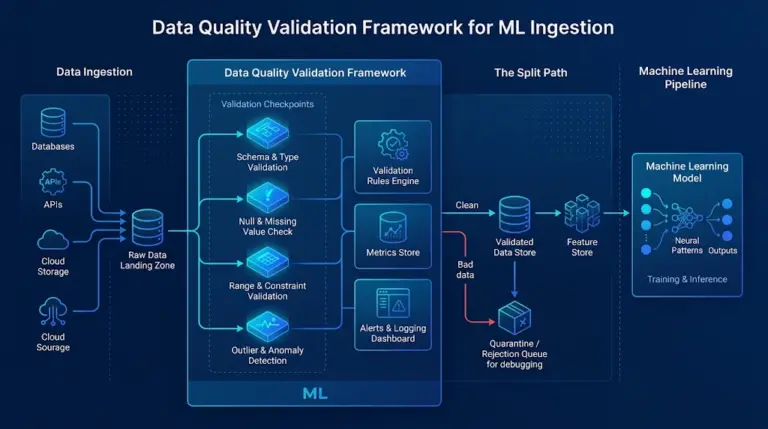
Incoming Data Events ➔ [Schema Verification Gate] ➔ Approved ➔ [Schema Registry / Iceberg Catalog]
                                  │
                              Rejected ➔ [Failed Message Queue (FMQ)] ➔ Pipeline Alerts
Step 1: Adopt a Central Schema Registry
Raw or unstructured data should never go directly into the production data lake without passing a verification gate. For real-time streaming data such as Kafka, use the Confluent Schema Registry; for serverless and batch workloads, use the AWS Glue Schema Registry.
Every payload a producer sends has to be checked against a registered schema ID with a version. Payloads that break the rules are not allowed to contaminate the lake: the pipeline either blocks them or sends the message to a failed-message queue where someone can inspect it manually.
Step 2: Treat Schemas as Code (CI/CD)
Like application code, schemas belong in git repositories. A team that needs a new column or a different data type should open a Pull Request (PR) with the revised schema, usually in Avro or JSON format.
Automated CI/CD pipelines can then test the proposal for compatibility against the schemas currently active in the registry. When a change would violate “Full Compatibility,” the build is marked as failed, and the developer has to revise the change or plan a data migration.
Step 3: Contain Breakages Gracefully with Failed-Message Queues and Alerts
Registries reduce breakages, but complex pipelines can still break. When schema validation fails, make sure the nonconforming data is isolated in quarantine. Engineers should get automatic alerts right away (through Slack, PagerDuty or email) whenever schema mismatches surge, so the issue can be resolved quickly, before downstream consumers are affected.
4. Putting Metadata Governance in Place
Schema evolution covers the structure of your data; metadata governance covers its context, history and use. Even a modern enterprise dataset has little value if consumers do not trust it, cannot tell how it was produced or do not know whether it is compliant.
Metadata usually falls into three separate layers:
A. Technical Metadata
Technical metadata describes the physical “how” and “where” of the data: table schemas, file paths, partition layouts, formats and sizes. Tools such as the Hive Metastore or the AWS Glue Data Catalog record it so that query engines (Presto, Trino, Athena) know where the bytes physically sit and how to interpret them.
B. Operational Metadata
Operational metadata covers the “when” and “how much” of processing. It captures data lineage, meaning the step-by-step path by which raw ingested data became a gold-tier BI table, along with audit logs, write times, run times and input and output row counts. Such records are vital when tracking down errors (for example, “Why is this KPI down 50% today? The 9 AM Spark job did not complete”).
C. Business Metadata
Business metadata expresses what the data means and why it exists. It holds data owners, glossary definitions, data quality scores and sensitivity labels such as PII, GDPR, HIPAA or PCI. Tools like Collibra, Alation or Apache Atlas can mark files as holding “sensitive user data” and apply access controls automatically.
5. Designing a Solid Enterprise Metadata Architecture
Protecting a data lake means building metadata governance tools straight into your engineering workflows.
[In-Process Data Lake] ➔ Metadata Scrapers / Listeners ➔ [Metadata Catalog] ➔ Data Discovery UI
                                                                   │
                                                       Access Controls (Ranger/IAM)
                                                                   │
                                                       Lineage Graphs & Compliance
- Catalog data continuously: Run discovery crawlers (Amundsen scrapers or the AWS Glue crawler, for example) that scan ADLS or S3 directories whenever data is written or changed. The catalog then stays current with new partitions and schema changes without anyone entering them by hand.
- Automate data lineage: Use tools such as dbt, OpenLineage or Apache Atlas to build data maps automatically. Before you drop a table or modify a schema, the lineage map lists every ETL job, dashboard and downstream table the change will affect, so you see the impact before acting.
- Enforce fine-grained access control (FGAC): Governance needs real enforcement. Platforms should rely on metadata tags to apply data access policies dynamically. With AWS Lake Formation or Apache Ranger, for example, you can mask every column tagged “PII” (Personally Identifiable Information), so that only authorized compliance officers can view unredacted credit card or phone numbers.
Conclusion
A successful data lake is not something you set up once and forget. It needs ongoing, automated attention.
Applying schema evolution through modern formats such as Iceberg or Delta Lake shields consumers from the breakage that schema drift causes. Meanwhile, strong metadata governance built on automated cataloging and lineage tools turns an unpredictable data store into a trusted, compliant enterprise asset. Putting these foundations in place early helps keep the data lake secure, flexible and valuable for years.
Frequently Asked Questions
Q1: When a schema evolves, what happens to the old data already in S3?
That depends on the table format and on the compatibility pattern in use. Modern formats such as Delta Lake or Apache Iceberg do not require old data to be rewritten; they rely on metadata map files to apply column additions or renames on the fly. Based on the newer schema, readers treat historical fields that are absent as NULL, with no manual migration needed.
Q2: How does schema evolution differ from schema enforcement?
Schema enforcement, also called schema validation, acts as a safety gate: it rejects any ingest or write request that does not match the expected schema exactly, which keeps corrupt data out. Schema evolution is the controlled process of permitting schemas to change smoothly over time, for instance by renaming or adding a column, without disrupting existing workflows.
Q3: Are schema registries only for streaming data?
No. Schema registries such as the Confluent Schema Registry are closely linked with streaming platforms like Apache Kafka, but they are just as valuable for batch work. Options such as the AWS Glue Schema Registry let ETL pipelines, bulk loaders and serverless queries apply identical schema standards before they process or write large batches.
Q4: Can metadata management be left to automated crawlers?
Crawlers such as AWS Glue Crawlers do a very good job of extracting technical metadata, including schema fields, partitioning and file sizes. They cannot, however, infer business metadata on their own, such as who owns a dataset, its business context or judgment-based compliance classifications. A hybrid model is required: automated tools for technical ingestion, and UI-based tools such as Alation or Collibra for input from people.
Q5: How does data lineage support compliance with rules such as GDPR or CCPA?
Lineage gives you a map of how data flows across the organization. When a customer asks for their personal data to be erased (the “Right to be Forgotten” under GDPR), the privacy team can use the lineage graph to find every system, file and table that ingests or processes that person’s data, so it can be removed completely from all downstream archives.